A Google Business Profile transfers to a buyer with its reviews, photos, and rankings intact — which makes it part of your sale price. Every owner eventually sells, hands over, or walks away, and the uncomfortable question a buyer will ask: when you leave, do the customers?
If the phone rings because of you — your name, your hustle, your referrals — the buyer is right to pay less. If it rings because your business owns its Google presence, that’s revenue that survives the handover, and buyers pay for it. Here’s how the asset works, and how to build it before you need it.
Is a Google Business Profile actually a transferable asset?
Yes — legally and practically. Profile ownership transfers to the buyer’s Google account with everything intact: the reviews, the photos, the ranking history, the years of accumulated trust.
So do a ranking website and consistent listings. Compare that to what doesn’t transfer: your personal reputation, your golf-course referral network, your face on the trucks.
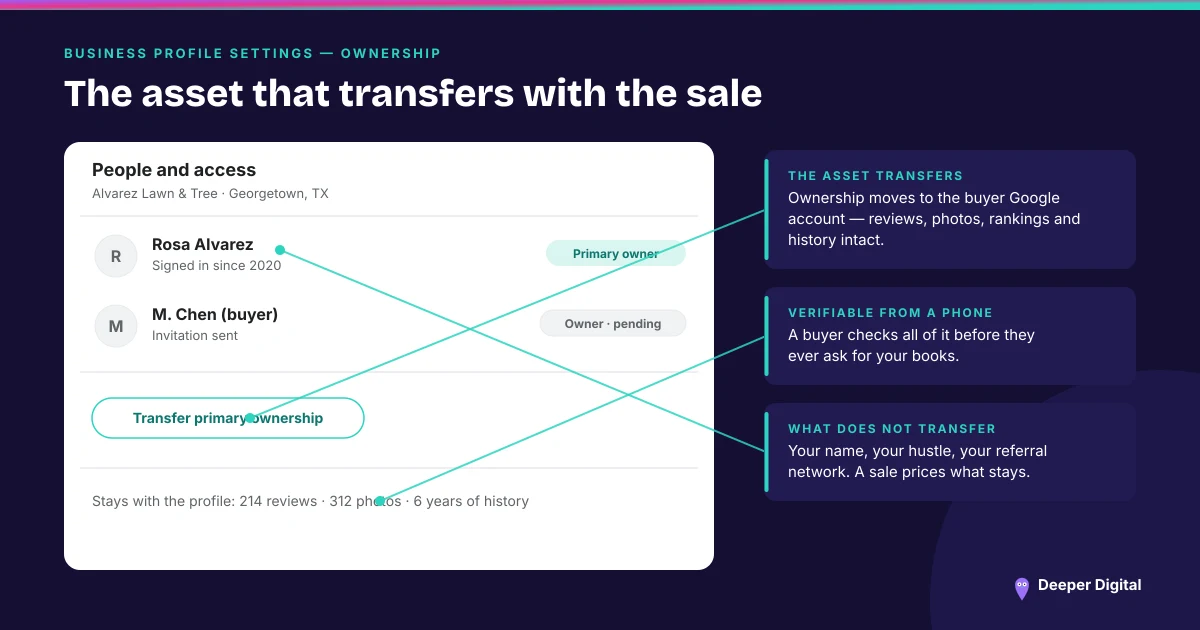
A sale prices what stays. This is the rare asset that never touches your balance sheet and still moves the offer. (What’s on the profile that makes it valuable.)
Why do buyers pay more for owner-independent customer flow?
Because they’re buying future revenue, and they discount anything that depends on the seller sticking around. A landscaping company doing $400k where the owner knows everyone is worth less than the same $400k arriving through “landscaping near me” — the second one keeps ringing for a stranger.
Brokers call this transferability; it’s a core driver of the multiple. Every month of steady reviews and pack presence is you converting personal goodwill into business value a buyer can verify from their own phone.
What does a buyer actually check?
The public record — before they ever request your books. They Google the business name and judge everything on that first screen: rating, review recency, photos, whether anyone’s home.
They search “[your service] near me” from your service area and see if you show. They’ll even ask ChatGPT who’s good in town. A dormant profile reads as a declining business regardless of what the P&L says — and first impressions price deals.
How long before a sale should you start building?
12–24 months minimum — because this asset can’t be bought at the last minute. Reviews only accumulate in real time (a sudden flood looks fake to Google and to buyers), rankings need months of consistent activity to hold, and a content-backed site (the topical authority play) compounds slowly then holds stubbornly. The best version: run it properly for years and let the asset build as a side effect of getting more calls today — the ROI math works on its own even if you never sell.
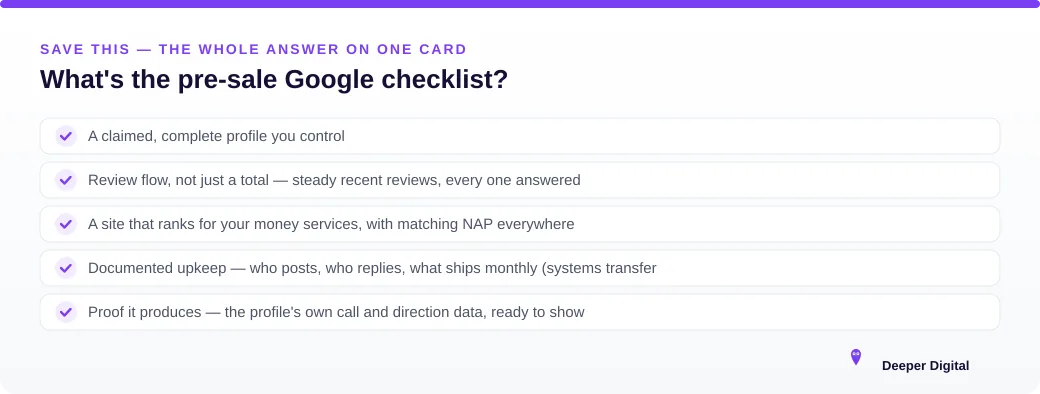
What’s the pre-sale Google checklist?
Five things a buyer can verify, which means five things that move the price:
- A claimed, complete profile you control — right category, full services, every service area
- Review flow, not just a total — steady recent reviews, every one answered
- A site that ranks for your money services, with matching NAP everywhere
- Documented upkeep — who posts, who replies, what ships monthly (systems transfer; habits don’t)
- Proof it produces — the profile’s own call and direction data, ready to show
The ownership fine print
One warning: if an agency runs your Google presence, confirm in writing that you own the profile, the website, the content, and the domain. Some shops hold rankings hostage — you leave, the asset vanishes, and so does that piece of your sale price.
It’s the first thing we put in our contract: everything we build is yours, guaranteed on exit.
Want to know what your Google presence is worth today? Grab a free game plan: we’ll show you the gaps a buyer would see.
 NASP
NASP  Wild Foods Co.
  Noble Origins
  Cowboy Pools
  BT Biltong