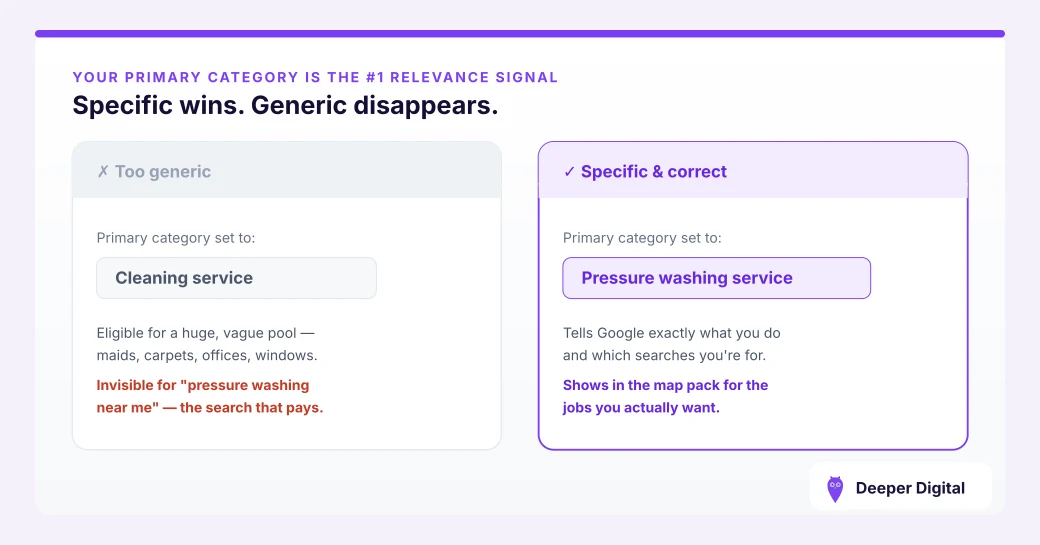
Your primary Google Business Profile category decides which searches you’re even eligible to rank for — it’s the single most powerful field on your profile. A pressure washer in Waco listed as a “Cleaning service” does driveways, not carpets. But Google took him at his word, so when someone searches “pressure washing near me,” he doesn’t exist. One dropdown menu is what’s standing between him and the map pack. Here’s how to set it right.
What does the primary category actually do?
Your primary category tells Google which searches you’re eligible to rank for. It’s the strongest single field on your profile — get it wrong and nothing else you do matters much, because you’re not even in the race for the searches that pay. It’s not just our opinion: in Whitespark’s Local Search Ranking Factors survey of local SEOs, the primary category is the number-one relevance signal.
Every audit we run checks this first. It’s wrong, or too broad, more often than you’d think.
How do I choose the right primary category?
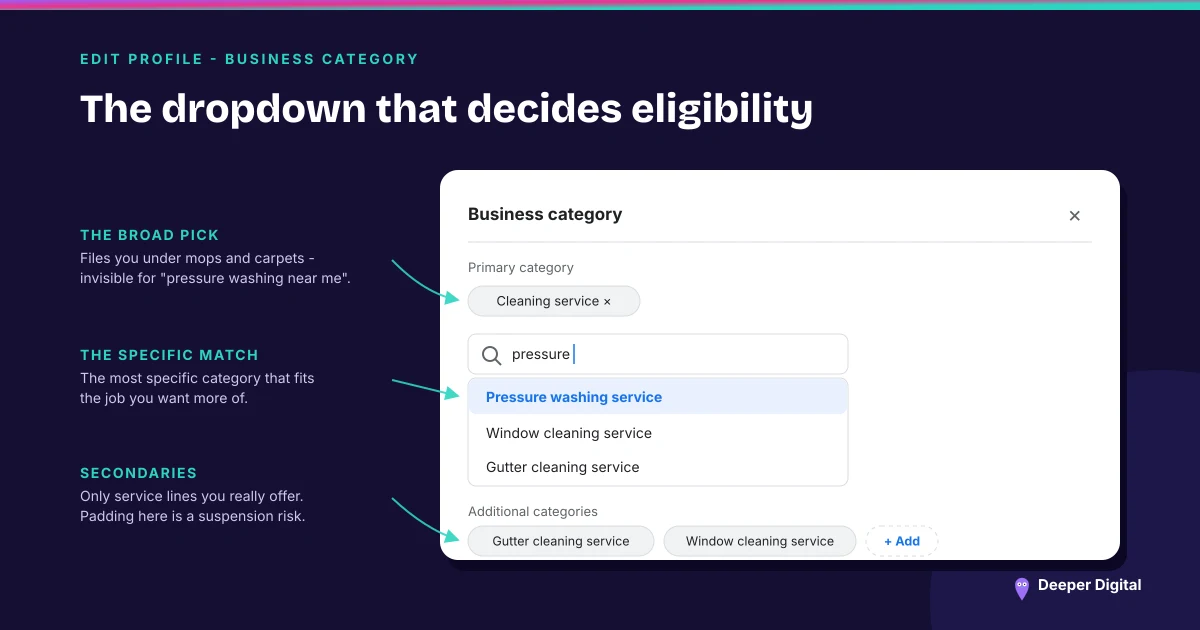
Pick the most specific category that matches the service you want more of. Not what covers everything you do — what you want the phone to ring for. This is exactly what Google’s own category guidance tells you to do: choose the most specific category that represents your main business, not one used as a keyword.
The test: search your money keyword in Google Maps and look at what the top three businesses list as their category (it shows on their profile). That’s the category Google associates with that search. Match it.
Rules of thumb:
- Specific beats broad. “Pressure washing service” beats “Cleaning service.” “Mobile car detailing service” (if available) beats “Car wash.”
- Your best-margin service wins the primary slot. If gutter cleaning pays your bills and window washing fills gaps, gutter cleaning is primary.
- You can change it. It’s not permanent. If your business shifted, your category should too — just don’t flip it weekly.
What about secondary categories?
Add every category you legitimately offer as a service — each one opens up eligibility for another set of searches. A pressure washing company that also cleans gutters should carry both.
Two warnings:
- Legitimately is the whole rule. Categories for services you don’t offer look like easy wins and get profiles suspended. A suspended profile earns nothing for weeks while you appeal.
- Don’t dilute. Ten scattergun categories blur what your business is. Three to five accurate ones beat a junk drawer.
Why hasn’t Google fixed my visibility if my category is right?
Because category is necessary, not sufficient. It puts you in the race; it doesn’t win it.
The rest of the race is the boring weekly stuff — services filled in, steady reviews, fresh posts and photos, accurate hours. Run the full 15-minute checklist to see where you stand.
And increasingly there’s a second referee: AI assistants like ChatGPT now recommend local businesses too, and they read your category and services just like Google does. Here’s how that works.
The 10-minute fix
Fixing your category takes about ten minutes: pick the most specific primary category, add legitimate secondaries, then fill in the Services under them.
- Open business.google.com → Edit profile → Business category.
- Search your main money service. Pick the most specific match.
- Add secondary categories for every real service line.
- Then open Services and fill in every service under each category — blank services waste the category you just fixed.
Not sure which category fits your business, or worried a change could hurt? That’s exactly the kind of thing our free game plan answers — we’ll check your profile spot by spot and tell you what we’d change and why. If you’d rather have the whole thing handled weekly, that’s what we do.
 NASP
NASP  Wild Foods Co.
  Noble Origins
  Cowboy Pools
  BT Biltong