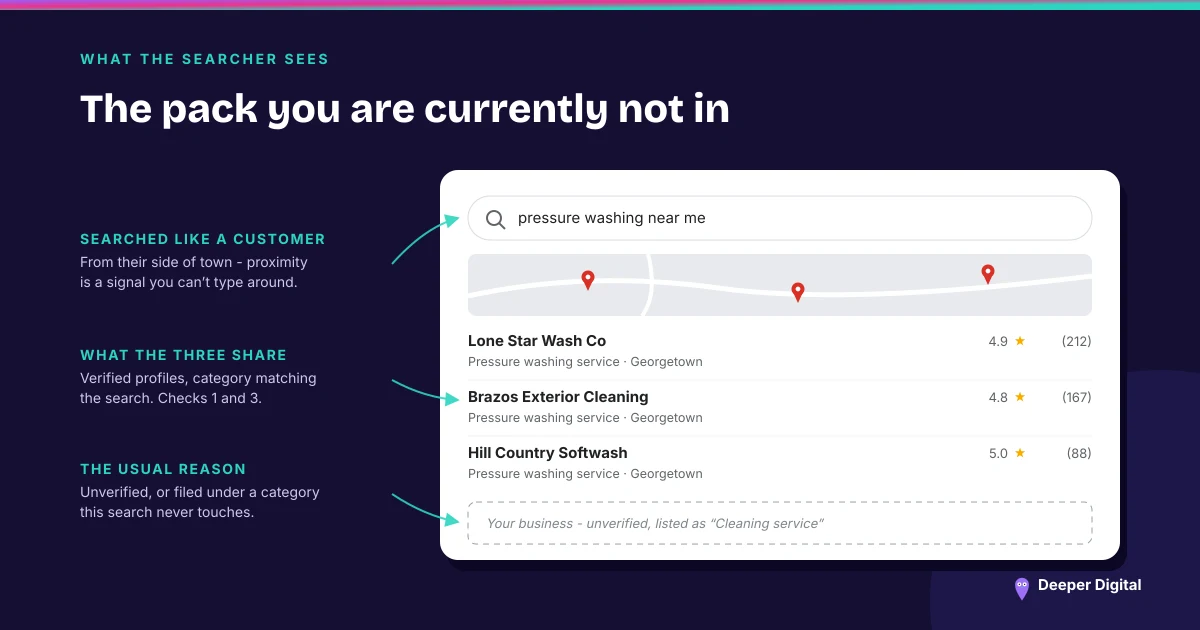
A justification is the short gray line Google prints under some map pack results, explaining why that business matched what was typed. It is quoted, not written — the text comes from something already attached to the business, and there is no field anywhere that lets you compose it.
Most owners notice them the way you notice a chipped tile: only after someone points at it, and then constantly.
”Their website mentions…”
The most common shape. Google has found the searched phrase on a page of the business’s site and prints it back as the reason.
This one is worth understanding because of what it implies about thin sites. A single-page site that says “detailing” and nothing else has one phrase available to be quoted. A site with a page per service has more. That is an argument for pages existing, not for keyword density, and the distinction matters — the phrase gets quoted verbatim, so it needs to read like something a person wrote. (Whether a local business needs a website at all.)
”Provides: …”
This one is pulled from the services list on the profile itself, which is the closest thing to a field you actually control. Google gives most service categories a menu of suggested entries plus the option to write custom ones. (How the services editor works, and the one rule about naming.)
An empty services list produces nothing. It is the single most common blank on the profiles we audit, and it is fifteen minutes of work.
The review snippet
Sometimes the line is a fragment of an actual review, in quotation marks, with the searched phrase inside it.
You cannot write these and you should not try to. What you can do is make the ask specific enough that customers mention what they hired you for instead of writing “great job, highly recommend” — which contains nothing Google can match to anything. (Building the ask so it produces reviews worth quoting.)
The post, the photo, the “in stock”
Other shapes appear and disappear. A recent post can be quoted. Retail profiles carrying in-store inventory get product justifications. The set is not fixed and Google publishes no list of it, which is why any article that gives you a definitive taxonomy of justifications is describing a screenshot from whenever it was written.
What Google actually says about all this
Nothing about justifications specifically. What it does say, on its own local ranking page, is that results are mainly based on relevance, distance and prominence — and, in a line worth reading twice, that there is no way to request or pay for a better local ranking.
Read those together and the honest position is clear. Justifications are a rendering of information Google already holds. You influence them the way you influence a quote in a newspaper: by what you said, not by asking for a particular sentence.
So what do you do with this
Fill the sources, then stop thinking about the output.
Services list complete, in the words customers use rather than the words your trade uses. Pages that name what you actually do. A review flow that produces specific text. Those are worth doing on their own merits — the map pack decides who gets the call whether or not a gray line appears under your name. (Why the pack, and not the blue links, decides it.)
Then look at your own pack occasionally and read what Google chose to quote. It is the closest thing to a free readout of what Google thinks you are.
Go read the line under your own name. If there isn’t one, an empty services list is usually why, and it is the shortest job on the free checklist. If you would rather all of it were somebody else’s job, the plans are here.
 NASP
NASP  Wild Foods Co.
  Noble Origins
  Cowboy Pools
  BT Biltong