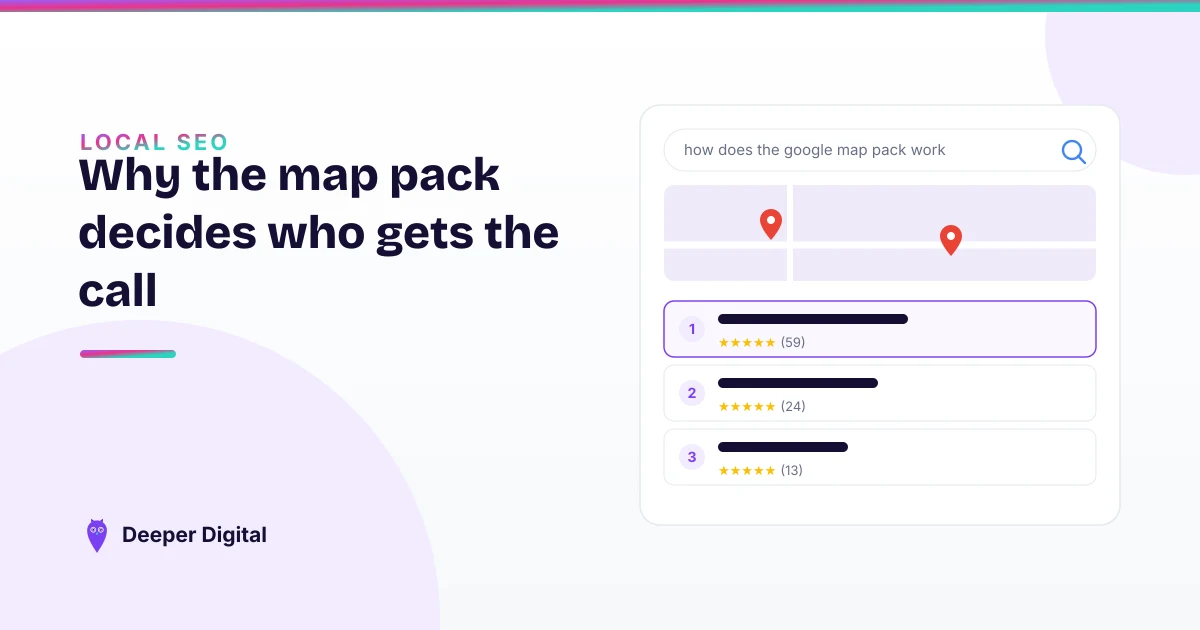
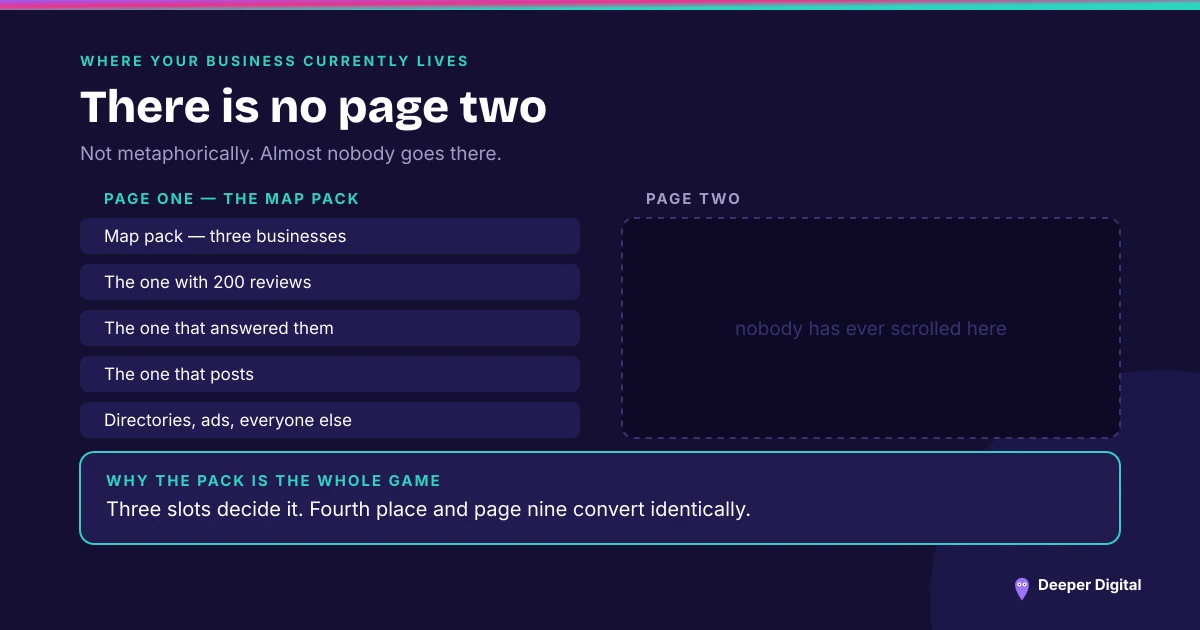
When someone searches “mobile detailing near me,” Google shows a map with three businesses pinned below it. That box is the map pack, and for local service work it’s the whole game. Most people call one of those three and never scroll.
If you’re not in the pack, you’re not in the running — no matter how good your work is.
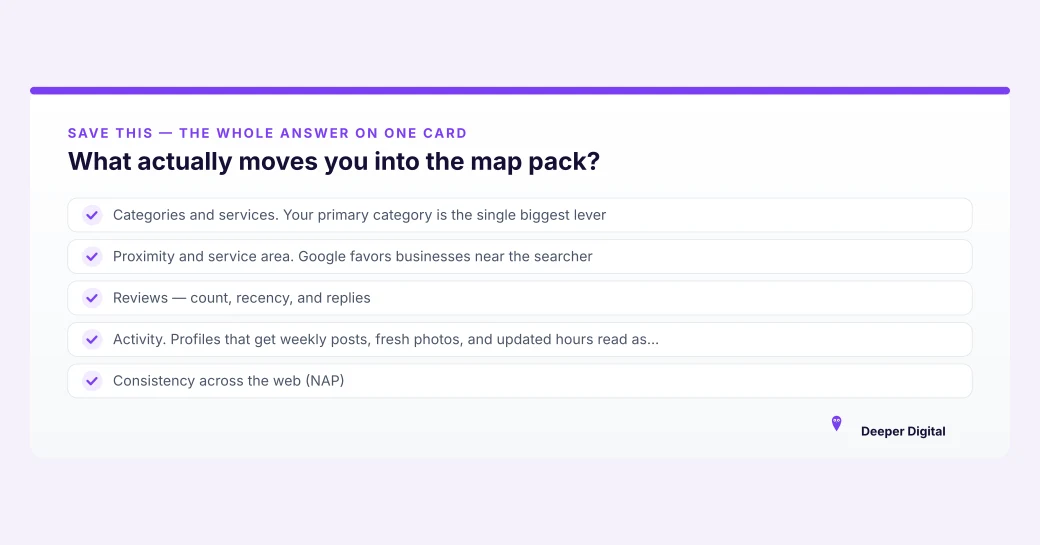
What actually moves you into the map pack?
Google ranks the map pack on a short list of things — its own local-ranking guidance boils it down to relevance, distance, and prominence, and independent studies like Whitespark’s Local Search Ranking Factors rank the specific levers. In rough order of leverage:
- Categories and services. Your primary category is the single biggest lever — here’s how to set it right. A mobile detailer listed under the wrong category is invisible for the searches that matter. Every service you offer should be filled in, not left blank.
- Proximity and service area. Google favors businesses near the searcher. You can’t move your shop, but you can define your service areas correctly and build local signals in the cities you want.
- Reviews — count, recency, and replies. A steady flow of recent reviews beats a big pile of old ones — the ask-system is here. Replying to every review is a signal too, and most competitors don’t bother.
- Activity. Profiles that get weekly posts, fresh photos, and updated hours read as “alive.” Dormant profiles slide.
- Consistency across the web (NAP). Your name, address, and phone need to match everywhere you’re listed. Mismatches quietly drag you down — here’s how to fix NAP consistency.
What can you safely ignore?
You’ll see people promise “#1 in 30 days” or sell you thousands of spammy citations. Skip it.
Fake signals get profiles suspended, and rankings that appear overnight tend to vanish the same way. Real movement in the pack comes from consistent, legitimate work over time — how long depends on your city, your niche, and where your profile starts. There’s no honest fixed timeline.
The honest version
There’s no trick. The businesses in the pack are almost always the ones whose profiles are set up correctly, kept active, and backed by real reviews. It’s boring work, and that is precisely why it keeps working: search your own category and count the profiles whose last post was March. That is your competition.
The gap isn’t talent. It’s that nobody does the dull part every week for a year.
We run this exact checklist on our own profile. If we ever tell you to do something we haven’t done to ourselves, ask why.
Want to see where your profile sits today? Start with the 15-minute checklist, see what we run every month, or grab a free game plan — we’ll show you your current map position and the top things holding it back.
 NASP
NASP  Wild Foods Co.
  Noble Origins
  Cowboy Pools
  BT Biltong