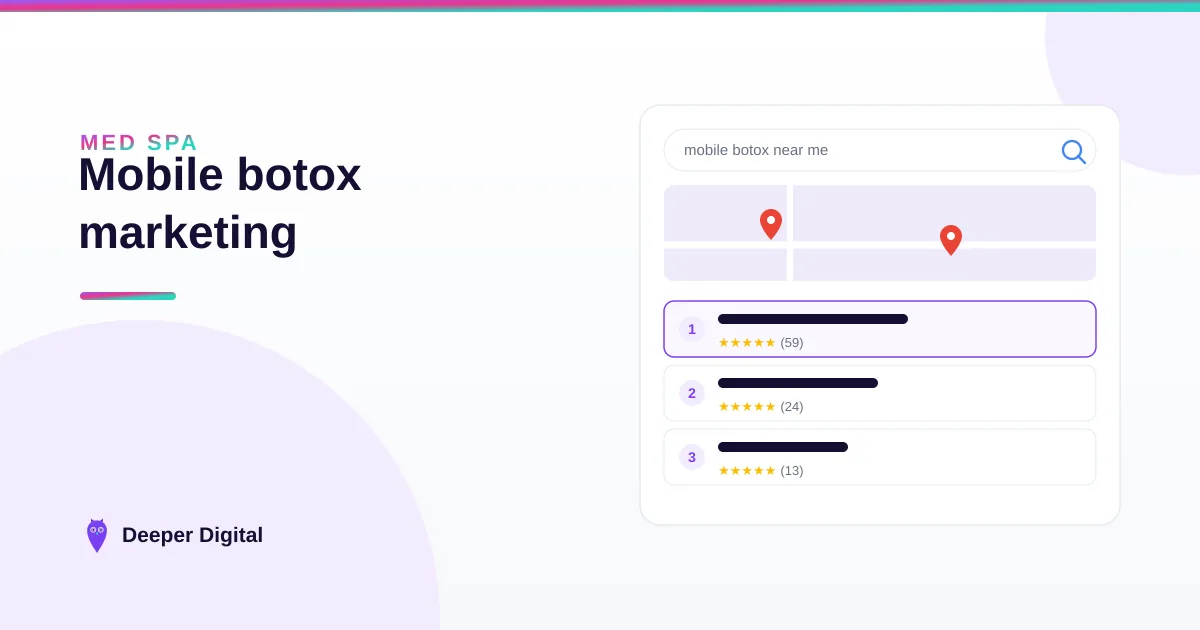
Botox SEO is local SEO for injectors: the Google Business Profile, the treatment list, the service areas and the reviews that decide which practices Google shows for “botox near me.” It changes which three names appear on the map, not what your website says about tox. Someone typing “botox near me” has usually finished deciding whether. They are deciding where, and that gets settled on Google Maps, in the three-listing map pack, before your Instagram ever loads.
That’s the gap in most injectors’ marketing. The feed reaches people who already follow you. The map reaches the person three miles away with a consult budget and no loyalty yet.
What does botox SEO change?
Which injectors Google is willing to show, and in what order. Nothing else on this list is under your control: not the competitor with 500 reviews, not the search volume, not what an AI assistant decides to say. What is under your control is the category, the services list, the service areas, the review flow and the listings. That’s all botox SEO services are, whoever you buy them from.
Which botox searches matter?
Two kinds, and they behave differently.
Booking searches (“botox near me,” “botox austin,” “lip flip near me”) trigger the map pack. The searcher wants a provider, this week. Your Google Business Profile does the work here.
Research searches (“how long does botox last,” “botox vs Dysport”) mostly don’t book anyone locally. They’re worth answering on your website as clear FAQ content, because those answers are also what AI assistants quote, but they are the second job, not the first.
What decides which injectors appear in the pack?
The same three levers as every local trade, relevance, distance and prominence (the full breakdown), expressed through a few fields most practices never finish:
- Primary category. “Medical spa” or the closest specific match to what you’re licensed to provide. Not a generic “Skin care clinic” if injectables are the business. The primary category decides which searches you’re eligible for at all. (Choosing it properly.)
- Botox as a named service. Google can’t connect you to a search for a service your profile never mentions. List Botox, Dysport, Xeomin (whichever you actually offer), each with a one-sentence, claim-free description.
- Review recency and volume. Steady beats sudden. And a note on discretion: never push a patient to name their treatment in a review. Recency and volume do the ranking work. The treatment details are the patient’s to share or not.
- Photos that are yours. Your injector, your room, your front desk. Stock photography is visible from across the street.
The copy standard is stricter in this trade than most: profile and website text is marketing material for a medical service, and it should be written and reviewed to make no outcome or medical claims. That keeps the board happy, and calm, careful copy also reads better than hype to a nervous first-timer.
How long before botox SEO changes anything?
The pieces move at different speeds, and knowing which is which is most of the patience. Profile fields are the fast half: a practice that never listed Botox as a named service is not eligible for that search at all, and it becomes eligible as soon as the service is live on the profile. Reviews are the slow half by design. Recency is what gets read, and recency cannot be backdated. Your own page is slower still, because it has to be crawled before it can hold a position against pages that have held one for years. Nobody can give you a date or a position for any of it, which is why what you are buying is named work and a monthly record of what shipped, not a forecast. (What moves when, across a whole engagement.)
Does the website matter for botox searches?
One page, on your own site, that names the service and the city in plain words, answers the questions patients ask before booking, and links to your booking flow. That page is where “botox [your city]” searches land when the map pack isn’t shown, and it’s the source material assistants read when someone asks them instead of Google.
What it shouldn’t be: a wall of adjectives. Name the service, name the place, answer the questions. (The med spa profile setup in full.)
What about ChatGPT and Gemini?
Patients now ask assistants who does botox nearby, and the assistants answer from the same public record: your profile, your reviews, your pages. Nobody controls what they say. What you can do is check: ask the question a patient would ask, monthly, and see whether the answer includes you. The fix for a bad answer is always the same profile-and-page work above. (Why a business gets skipped.)
The short version
The injector who appears for “botox near me” is the one whose profile names the service, whose reviews are recent, and whose website says in plain words what the practice does and where.
The rest of the injectable searches
Botox is one term in a family, and each one is typed on its own. Dermal filler and lip filler are researched longer and more nervously than tox. Mobile Botox is a near-empty search in most Texas metros. “Medical aesthetics” and “aesthetic clinic” are industry words that show up in agency searches more than patient ones, and “cosmetic clinic” is the same story under a different label. What patients actually type when they want injectables is the pattern behind all of them, and replying to reviews without a HIPAA problem is the question every practice asks before it starts.
If you’d rather hand that work off: we manage the profile, write the posts, answer every review within one business day, and report each month on exactly what shipped. Start with the med spa SEO company page, or get a free game plan for your market.
 NASP
NASP  Wild Foods Co.
  Noble Origins
  Cowboy Pools
  BT Biltong