“#1 on Google in 30 days” is always a scam: nobody can guarantee a Google ranking, and Google says so itself. If you own a service business, you’ve gotten the call — “We noticed your Google listing isn’t optimized. We can have you ranked #1 in 30 days. $99 a month.” Every part of that pitch is a lie, including the part where they noticed anything. Here’s how to spot the con — from people who do this work for a living and are tired of cleaning up after it.
Why is “guaranteed #1 ranking” always a scam?
Because nobody controls Google’s results — not us, not them, not anyone. Google says so itself: in its guidance on hiring an SEO, Google states plainly that no one can guarantee a #1 ranking and warns you to beware of anyone who claims to, or who alleges a “special relationship” with Google. Rankings are Google’s decision, made by algorithm, influenced by dozens of factors including your competitors’ moves.
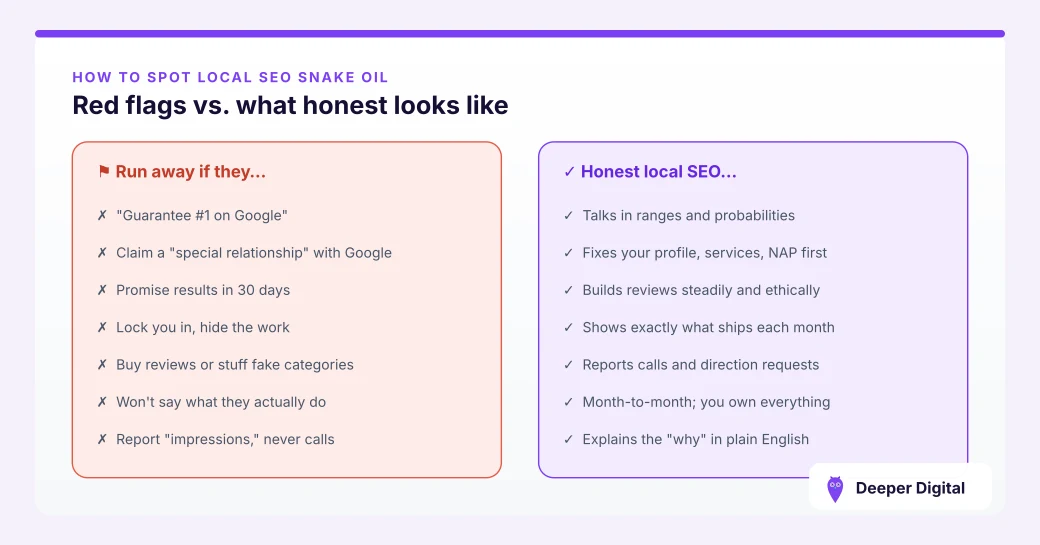
A vendor can guarantee work — what they’ll do, in writing, checkable at the end of the month. A vendor who guarantees outcomes is lying about the one thing you’re paying them for.
Real local SEO movement comes from consistent, legitimate work, and how long it takes depends on your city, your niche, and where your profile starts — here’s what actually moves the map pack. Anyone promising a specific result by a specific date is either lying or doing something that gets profiles penalized.
What are the classic local SEO scams?
Six pitches that should end the call:
- The ranking guarantee. Covered above. Hang up.
- “Google Partner” cold calls claiming to BE Google. Google does not call you about your listing. Ever. Anyone implying they’re Google is opening with fraud.
- The citation blast. “We’ll submit you to 500 directories!” Volume citations are worthless at best; inconsistent ones actively hurt the trust signals both Google and AI assistants read. You need a couple dozen that are accurate.
- Fake review packages. Bought reviews violate Google’s policies and increasingly get caught — the penalty is losing the reviews or the whole profile. The legitimate review system is free and works.
- The $99/month black box. No reports, no list of what was done, “trust us, it’s technical.” At that price the honest math is: nothing is being done — here’s what local SEO actually costs and why. Real weekly profile work takes real hours.
- The “voice search registration” call. (Added August 2026 — one of these called us. A local SEO agency. To register it for voice search.) The pitch: your business “can’t be found in voice search” and needs registering, monthly fee attached. There is no voice-search registry. Siri, Alexa and Google Assistant answer from the same free sources ordinary search uses — your Google Business Profile, your reviews, your listings. Google sells no such service, and nobody legitimate opens with a warning that you’re unlisted. If they call: hang up, confirm nothing, and never read back a verification code someone texts you — the code, not the call, is the actual theft.
What does honest local SEO look like?
Three tells, all checkable in the first conversation:
- They guarantee deliverables, never rankings. A specific list: posts per week, review replies, services built out, reports sent. You can verify every item happened.
- They show you the work. A real audit up front — your profile versus your market’s top three, gap by gap — and reporting that lists actions taken, not just a traffic graph.
- They put skin in the game. The best proof an SEO can offer is ranking something of their own. Ask what they’ve ranked. (Ours is our own profile — run with the exact system we sell.)
That deliverables-not-rankings line isn’t marketing modesty, by the way. It’s the structural difference between a vendor who profits from doing the work and one who profits from you not checking.
What questions expose a bad vendor fast?
Ask these, in order:
- “What exactly will you do in month one? List it.” (Vague = run.)
- “Can you guarantee me a ranking?” (Yes = run. The correct answer is no, with an explanation.)
- “How do you get reviews?” (Anything but “we help you ask real customers” = run.)
- “What have you ranked that I can look at right now?” (Nothing = why are they selling this?)
- “Who owns my profile and website if we part ways?” (Not “you” = run twice as fast. Hostage-taking via account ownership is the exit scam.)
What if you’ve already been burned?
Get your logins back first — your Google Business Profile should be owned by your account, with vendors as managers. Then audit the damage: check your categories are real (here’s how), scan for fake reviews, and run the 15-minute checklist to see what was never actually done.
Or let us do that part: the audit is free, spot-by-spot, nothing attached — it’s how we win trust in a market these guys poisoned. What we’d actually do each week is all listed here.
Deliverables guaranteed. Rankings never. Now you know why that sentence is on every page.
 NASP
NASP  Wild Foods Co.
  Noble Origins
  Cowboy Pools
  BT Biltong