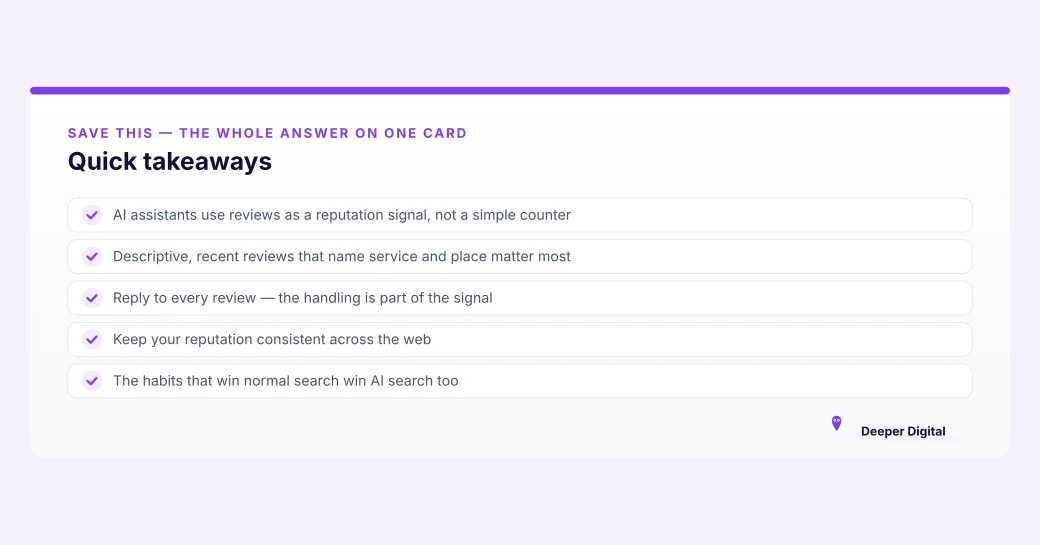
Being named by an AI assistant does not end the search — it starts a verification step. In BrightLocal’s Local Consumer Review Survey 2026, 88% of the people who use AI for local recommendations said they check what it told them, and 97% said they at least sometimes go and read real reviews before deciding. The assistant hands them a short list. Something else closes the job.
That distinction is the whole strategy, so it is worth walking through the sequence as the customer experiences it.
Stage one: the assistant shortens the list
The survey, published 10 March 2026 from a panel of 1,002 US adults, put AI use for local recommendations at 45%, up from 6% a year earlier — third behind Google and Facebook as a way people find local businesses. ChatGPT led the tools at 31%, with Google’s AI Mode next at 23%.
What arrives on screen is three or four names and a sentence about each. No pack, no map, no reviews. Just a list, generated from public sources, which is why the sources an assistant reads determine who is on it.
Stage two: the reader stops trusting it slightly
The same survey found only 12% of AI users take the answer at face value. The other 88% check something: 51% look at whether a review is legitimate, 37% look for the source.
This is not skepticism about your business. It is skepticism about the machine, and it works in favor of any business whose public record holds up under a look.
Stage three: the review profile decides it
Of the people who read an AI-generated summary of reviews, 59% went on to open the review profile itself. 42% of AI users said they always check reviews on a native review platform after an AI recommendation.
So the profile is not upstream of the AI answer or downstream of it. It is both — the source the assistant reads, and the page the reader lands on to audit what the assistant said. A profile with four reviews, the newest from last spring, is at its most exposed in exactly that moment. Recency is doing visible work here, which is the argument in review velocity.
Stage four: they call somebody
Nothing in the survey suggests AI shortened the last step. Somebody still picks up a phone, taps a booking link, or sends a message — and the business that answers is the one that gets it. That is a separate problem from being named, and it has its own failure mode.
What this changes about the work
Very little, which is the useful part.
The tasks that make a business legible to an assistant are the tasks that make it legible to a person: an accurate profile, information that matches everywhere it appears, reviews that keep arriving, and plain descriptions of what you do and where you do it. There is no separate AI channel to buy into. There is only whether the public record about you is accurate and current enough to survive being read twice — once by a model, once by the person double-checking the model.
What does change is the cost of being wrong somewhere obscure. An old address on a directory nobody visits used to be a rounding error. Now it is a sentence a model might repeat, to a reader who is about to go looking for confirmation.
The one thing worth doing this week
Run the prompts your customers would run and read what comes back about you. Not to celebrate or panic — to find the sentence that is wrong. Here is the test, step by step, and here is what to look at when you are not named at all.
Nobody sells placement in an AI answer. What every plan includes is the profile work those answers are built from — and your free game plan shows you, screenshotted and dated, what the assistants say about your market today. Start here.
 NASP
NASP  Wild Foods Co.
  Noble Origins
  Cowboy Pools
  BT Biltong