ChatGPT names a local business by reading ordinary web pages — most of which the business does not own. There is no AI index to join and no submission form. The sources are the same public pages a search engine reads, pulled at the moment someone asks.
That single fact decides the whole job. You are not optimizing for a model. You are making sure the pages other people wrote about you say the right thing.
The surfaces that describe a local business
Six kinds of page carry most of what an assistant can learn about a service business:
- Your own website. The only source you control outright. Services, service area, hours, and who you are, stated in plain sentences rather than implied by a hero image.
- Your Google Business Profile, as it appears around the web. Category, services list, hours and review content surface in far more places than Maps, and those copies get read.
- Review platforms. Google reviews first, then whatever else your trade collects — the text carries more description than the star average does.
- Directories and trade listings. Old ones outlive their usefulness quietly. A defunct suite number sitting in a directory from 2019 is still a published fact about you.
- Local roundups and press. “Best mobile IV in Austin” listicles, chamber pages, local news mentions. You rarely control these and they get read anyway.
- Public social and forum posts. Anything indexable — your own posts included.
Notice what four of those six have in common: someone else maintains them.
Agreement is the whole game
An assistant reading six sources about you cannot referee a disagreement between them. If your hours differ across three surfaces, or a directory carries a phone number you stopped using two years ago, there is no mechanism that decides which one is true. The safest output is a business the assistant can describe confidently — which is usually one whose sources all say the same thing.
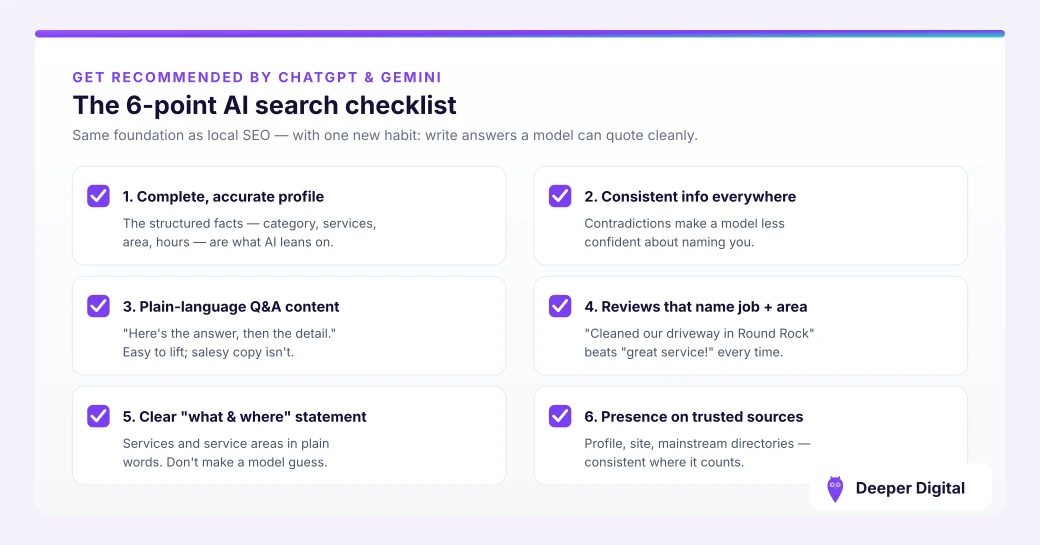
This is why the unglamorous work — categories, services, hours, citations kept current — is the same work that shows up here. It is not a second discipline. (The full checklist is here.)
How to see it for yourself
Ask an assistant, with browsing on, the question your customer would ask: your service plus your city. Then open every citation it shows. That list is not a guess about what it read — it is what it read, for that answer, that day.
Two things are worth writing down. Which sites keep appearing for your category in your town, and whether anything they say about you is out of date. Both are fixable. Neither requires a tool.
The short version
The sources are public pages, most of them written by other people. Accuracy across all of them beats cleverness on any one of them.
We keep the readable surfaces in agreement — profile categories, services, hours, and reviews answered within one business day. See how AI assistants pick which local businesses to name.
 NASP
NASP  Wild Foods Co.
  Noble Origins
  Cowboy Pools
  BT Biltong