Published August 13, 2026 · by

Review velocity: why five recent reviews beat fifty old ones

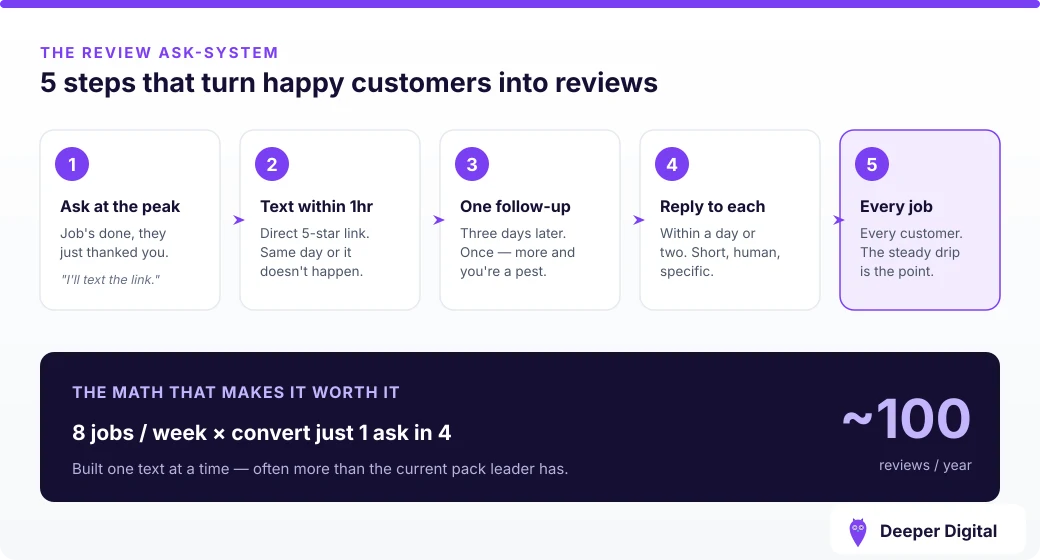
The five-step review ask-system: ask at the peak, text within an hour, one follow-up, reply to each, run it on every job — with the math showing about 100 reviews a year from eight jobs a week

A profile with 50 reviews sounds better than a profile with 20 — until you look at the dates. Fifty reviews, newest one from 2023, tells a story: something was working then. It says nothing about now.

A wall of five-star reviews from three years ago answers a question nobody asked.

What recency signals, and to whom

Two audiences read your reviews, and both weigh fresh ones more.

Readers sort by newest, because they’re hiring the business that exists today — current staff, current prices, current standards. The newest review is the closest thing they have to a reference check.

Google’s systems treat reviews as one signal among many, and a profile accumulating recent activity — reviews, replies, posts, photos — looks like an operating business. A profile whose last visible event is years old looks like a question mark. (What actually moves map rankings.)

Why totals mislead

Big totals usually date from an era: a push in 2022, an owner who used to ask and stopped. The total keeps its size while its meaning quietly expires. Meanwhile a competitor collecting three reviews a month walks past — not because their history is longer, but because their evidence is current.

The failure mode on the other side is the burst: fifty reviews in a week after years of quiet. Genuine or not, it’s the exact shape purchased reviews take, and it’s the shape review filters watch for. Velocity means steady, not sudden.

Cadence is a system, not a campaign

Nobody sustains a review flow on memory and good intentions. The businesses that do it run the same loop: every finished job triggers an ask, by text, with the direct link, same day. One follow-up. Then the next job does it again. (The full ask system, and replying well — replies are the half of velocity you control completely.)

The short version

Review count is history; review velocity is evidence. A steady monthly flow, asked for after every job and answered promptly, beats a big stale total on both surfaces that matter.

Building that loop is part of what we run — the ask after every finished job, and every review answered within one business day. See what’s included, or request a free game plan.

Common questions

Do recent Google reviews matter more than the total count?

Both matter, but they answer different questions. The total says how many customers have ever spoken up; recency says whether customers are still choosing you and still happy. A reader deciding between two businesses reads the newest reviews first, and a profile whose latest review is years old leaves the most important question — what is this business like now? — unanswered.

What is a good review cadence for a local business?

Steady beats impressive. A consistent flow — some reviews every month, arriving as jobs finish — reads as a business in regular motion, to Google and to people. The number that fits varies by trade and volume; the pattern that fits every trade is the same: reviews arriving continuously because every finished job generates an ask.

Is it bad to get a lot of Google reviews all at once?

A sudden burst after years of silence is a known pattern of purchased or pressured reviews, and both readers and review filters have seen it before. Even when every review in the burst is genuine, it buys one good month and returns the profile to silence. A system that asks after every job produces the same total, spread out, with none of the risk.

How do you ask customers for reviews without being pushy?

Ask once, right after the finished job, by text, with the direct link — while the experience is fresh. One polite follow-up if nothing happens. That is the whole method; volume comes from applying it to every job rather than pressing harder on any one customer.

← All posts

Worked with top brands

NASP logo Wild Foods Co. logo Noble Origins logo Cowboy Pools logo BT Biltong logo Manic Expressive

Everything in this guide, done for you.

Start with a free rank check + game plan: exactly where you sit on Google today, what's quietly costing you calls, and what it takes to own your map. No cost, no card, no pitch-slapping. If you want it handled: from $349/mo plus a one-time $499 setup, three months to start then month to month. Every deliverable in writing — a month we don't deliver is free.

Get my free game plan →

Every deliverable on the card, guaranteed — or the month’s free · Or call Calvern: (512) 537-4481

Get more clients →