A redesign is the only marketing project that can lose you customers on the day it succeeds. The site looks better, everyone agrees it looks better, and three weeks later the calls are down and nobody connects the two events because the new site is obviously an improvement.
The cause is almost never the design. It is the addresses.
The URLs changed and nothing else was told
If your services page moved from one address to another, every link pointing at the old one now points at nothing. Some of those links are yours and easy to fix. Most of them are not yours at all.
A redesign that preserves every URL exactly is a low-risk project. A redesign that reorganizes the site — which is usually the point — needs a map from every old address to its closest new equivalent, and a redirect for each one. That map is the deliverable that matters most and the one most likely to be skipped, because it is the least visible thing in the project.
The profile link points at a page that moved
Your Google Business Profile carries one website link, and on a lot of profiles it points at something more specific than the homepage — a services page, a booking page, a location page.
Those are exactly the URLs a redesign renames. The link keeps working right up until it doesn’t, and a profile link landing on an error page is a customer lost at the last step, after everything else worked. Check it by hand on launch day and confirm it points where it should be pointing rather than where it used to.
The citations are worse, because you cannot edit most of them
Directory listings, aggregators, chamber pages, supplier pages — many carry your website address as plain text somebody typed once. A redirect covers the visitor. It does not correct the record.
Some of those you own and can update. Some you rent, some you have no access to at all, and the difference between those categories is the whole argument in citations you own versus citations you rent. Launch week is when you find out which ones you can actually reach.
While you are in there: confirm the phone number and address on the new site match what every listing says, character for character. Redesigns are a common moment for a phone number to be retyped, and a mismatch introduced this way spreads quietly.
The schema still describes the old site
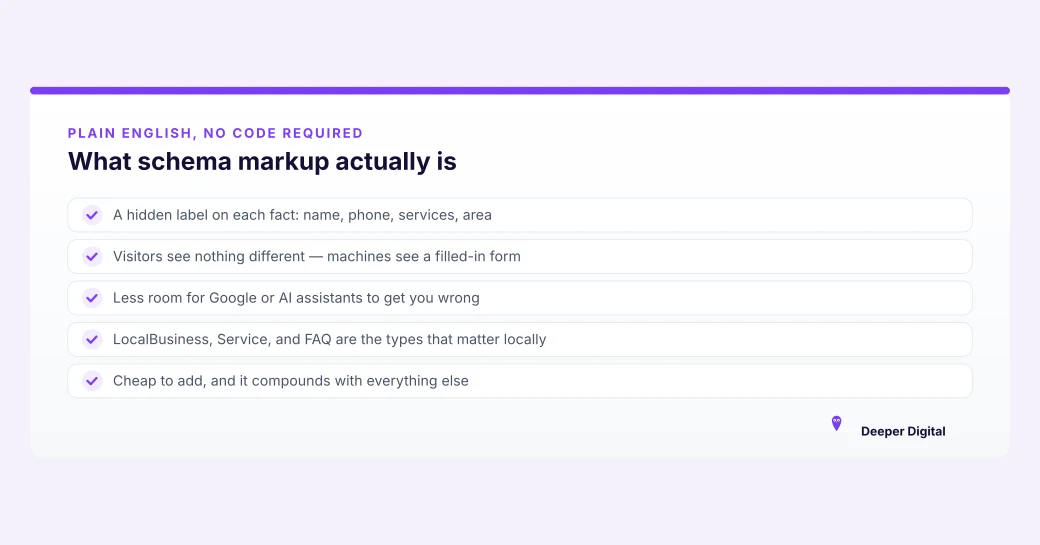
Structured data is generated by templates, and templates carry URLs. After a rebuild it is routine to find JSON-LD referencing the previous address scheme — old paths, or the old slash convention, sitting in the machine-readable layer where nothing visibly breaks.
Nothing looks wrong on the page, which is precisely the problem. Pick the convention and then go and read what your schema actually says, in the built output rather than in the source, because the source is where the template lives and the output is where the truth is.
The form that quietly stopped delivering
Contact forms break in redesigns more often than anything else on this list, because the form is the one component that has to be rewired rather than restyled. It submits, it shows a success message, and the email goes nowhere.
Test it by submitting a real one and waiting for it to arrive. Then test every other way someone can reach you, because each contact surface is a separate mechanism and they fail independently.
The launch-week checklist
- Every old URL redirects to its nearest new equivalent — spot-check the ten that got the most traffic.
- The profile website link opens a live page.
- The structured data references current addresses.
- The contact form delivers to a real inbox, tested by submitting one.
- Phone number and address match every listing you can reach.
Do these in the week of launch, not the month somebody notices. The immediate failures — dead links, dead forms — cost contacts from day one, and the slower ones are much harder to attribute once several things have changed at once.
If a rebuild is coming, the map from old URLs to new ones is the thing to insist on before anything ships. The profile, the citations and the listings that all point at your site are what we keep current every month; the build itself is separate work, priced separately.
 NASP
NASP  Wild Foods Co.
  Noble Origins
  Cowboy Pools
  BT Biltong