A citation you own is a listing created directly on a directory, where you hold the login and it stays published forever without another payment. A citation you rent is published for you by a subscription service and withdrawn when you stop subscribing. While you are paying, you can’t tell them apart. Not in a report, not in a search, not in any way a buyer could check.
Why the report cannot tell you
A citation audit shows which directories list your business and whether the name, address and phone match. Useful. Also the entire scope. There is no column for whether a listing survives your next invoice.
So a vendor’s report can show a healthy set of citations, every one of them accurate, and it will look the same on the last month of a subscription as on the first. The number is real. What the number is made of is the question the report does not ask.
How the rented model works
Subscription syndication is a real product with a real mechanism. A service holds your business data and pushes it out to a network of partner directories, keeping the entries current for as long as you subscribe. Yext is the best-known of them and describes the arrangement plainly: the listings are maintained through the subscription.
That is a rental, and rentals are legitimate. A franchise with two hundred locations changing a phone number once and having it propagate everywhere is buying something worth paying for every month.
The mismatch is a single-location service business paying indefinitely for entries it could have created once and kept. Renting is fine. Renting while believing you bought is the expensive part.
The listings you can simply hold
Most of the citations that matter for a local service business are ownable, free or close to it, and yours permanently once created:
- Your Google Business Profile, which is the one everything else supports
- Bing Places and Apple Business Connect
- Yelp and Facebook
- Your chamber of commerce and any trade association you belong to
- Local business groups, city and county directories
- The trade-specific directories your customers browse
Each is an account with a username and a password. Created once, corrected when your details change, gone only if you delete it.
The two questions
Ask any vendor selling citation work, before you buy:
- If I stop paying you next month, which of these listings disappear?
- Will you hand me the logins?
A clear answer to the first is a good sign regardless of which way it goes. An inability to answer the second is the answer.
Worth adding a third for whoever is doing the work: whose name is on the accounts. An agency creating listings under its own credentials leaves you with citations that are technically owned by somebody else, which produces the same problem by a different route.
Why any of this matters
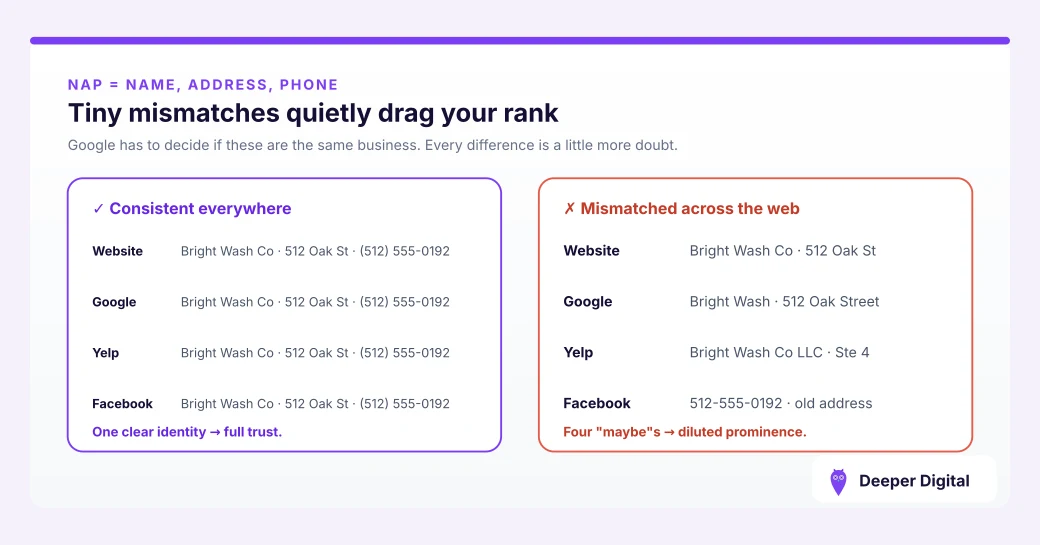
Citations do their job by agreeing with each other. A consistent name, address and phone across directories is the evidence Google uses to be confident your business is where you say it is, and inconsistency is what quietly undermines it. A number nobody ever submitted can create that disagreement on its own, which is how a call tracking number ends up in a citation set. (What name, address and phone consistency actually requires.)
Rented citations agree beautifully right up until they are withdrawn, at which point the set you were relying on partially unwinds and directories revert to older, wronger data. That is a worse position than never having had them, because the old entries are back and nobody is watching.
The short version
Own the listings if you are one business in one city. Rent them if you are two hundred businesses and intend to keep paying. Ask which is which before you buy, and get the logins.
Citation work should leave you holding the accounts, with the details kept matching as they change. That is how we build it. See what’s included.
 NASP
NASP  Wild Foods Co.
  Noble Origins
  Cowboy Pools
  BT Biltong