A local business website needs three contact surfaces, and they are not interchangeable: a phone number for the visitor ready now, a contact form for the one who is not, and a quote request for the one whose job needs describing before anyone can name a price. Most sites have some of these, styled as afterthoughts, and treat whichever one exists as equivalent to the others. The visitor does not.
This is the page-level layer of a stack this blog has covered from the other end — where the leads land once they exist is a different question from whether the page gave the visitor a way to become one.
The phone number: for the visitor who is ready
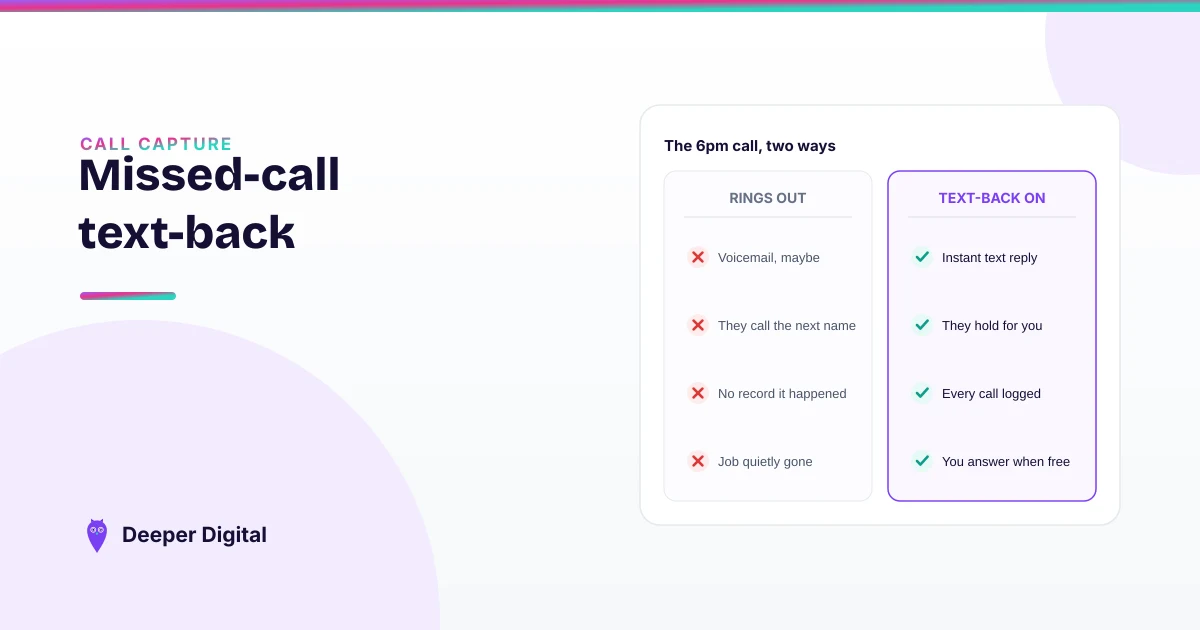
Some fraction of your visitors have already decided; they are looking for the number, and every second it hides costs you a percentage of them. The number belongs on every page, visible without scrolling, and tappable on a phone — which is where most local searches happen. The industry made “sticky header with a call button” a cliché because it keeps working. And once the calls come, the expensive failure moves off the website entirely: the missed call is the most expensive thing in your business, and no page design fixes an unanswered ring.
The form: for the visitor who is not
The form is for the researcher, the after-hours browser, and the person who would rather write than talk — a group that includes a lot of people with money. A form’s enemy is its own length. Every field you add is a small toll, and tolls turn people around. Keep it to what starts a conversation. The form’s other enemy is silence after submission: a form that answers with nothing teaches the visitor they should have called someone else.
The quote request: for the job that needs describing
Trades with variable work — a detail on a boat versus a sedan, a deep clean versus a maintenance visit — need a third surface: the quote request, a form that asks about the job. Its role is different enough to deserve its own button and its own promise, because the visitor filling it out expects a number back, not a newsletter. Ask what you need to quote honestly; say when they will hear from you; then hit that mark.
One page, all three
The contact page itself should offer all three surfaces and let the visitor pick. Its job is not to funnel everyone to your preferred channel; it is to remove every reason to leave. The businesses that get this right treat “contact us” as the most valuable page on the site rather than the one the template filled in.
To be plain about the line: your website’s buttons, forms and pages are your build — no plan of ours includes website changes. Our work starts at the profile that sends the visitor and, on the plans that include it, the inbox that catches what comes back. What sits between those two is yours.
 NASP
NASP  Wild Foods Co.
  Noble Origins
  Cowboy Pools
  BT Biltong