Getting recommended by ChatGPT and Gemini takes six things, all of them local-SEO fundamentals: a complete Google Business Profile, consistent business information, plain question-and-answer content, specific reviews, a clear statement of what you do and where, and presence on trusted sources.
Your next customer might never type a search into Google. They might ask ChatGPT, “Who’s a good mobile detailer near me?” — and act on whatever it says. That shift is already happening, and most local businesses have done nothing to prepare for it.
The good news: the work that makes you visible to AI assistants overlaps heavily with good local SEO. Here’s the checklist. It’s the same one behind our deeper guide to getting ChatGPT to recommend you.
How do AI assistants decide which local business to recommend?
They pull from the open web and from the same signals that power local search: your Google Business Profile, the consistency of your business information across the web, your reviews, and clear, plain-language content about what you do and where. AI models favor businesses whose details are unambiguous and repeated consistently across trusted sources. There’s no secret “AI ranking” setting — there’s just being clearly, consistently the obvious answer.
The AI search checklist for local businesses
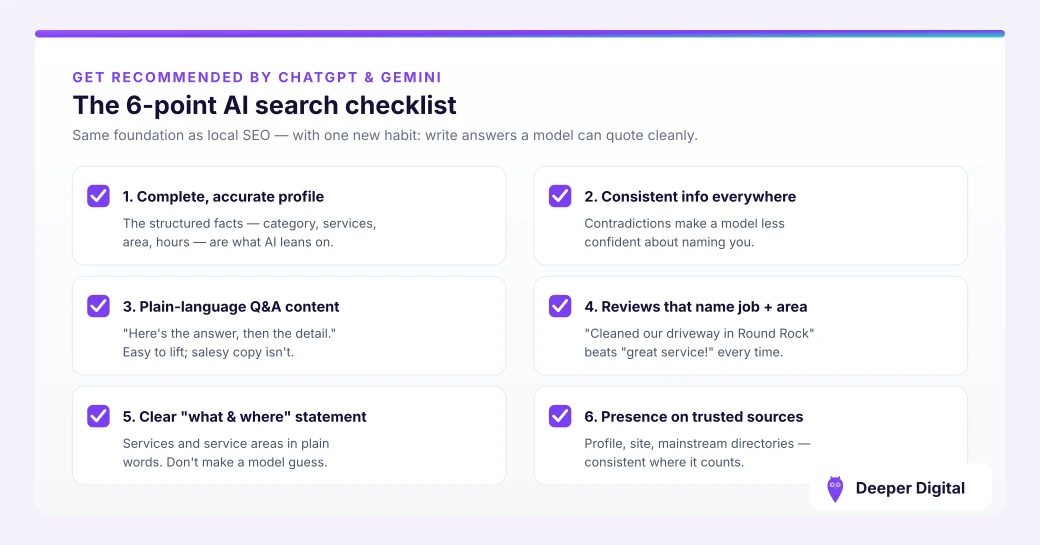
1. A complete, accurate Google Business Profile. This is still the foundation. AI assistants lean on the structured facts in your profile — category, services, area, hours. If yours has gaps, run the profile checklist first.
2. Consistent business information everywhere. Your name, phone, and location need to match across the web. Contradictory details make an AI less confident recommending you. Here’s how to clean up NAP consistency.
3. Plain-language answers to real questions on your site. AI models quote content that directly answers a question in clear language. Pages written as “here’s the answer, then the detail” — the way this post is — are easy for a model to lift. Vague, salesy copy isn’t.
4. Reviews that describe the actual service and place. Reviews are one of the ways AI systems judge reputation. Reviews that name the job and the area (“detailed our SUV in Round Rock”) are more useful to a model than “great service!” — and there’s a way to prompt for those.
5. A clear statement of what you do and where. Somewhere obvious, in plain words: the services you offer and the areas you serve. Don’t make a model guess.
6. Presence on the sources AI trusts. Your profile, your website, and mainstream directories with matching information. You don’t need to be everywhere — you need to be consistent where it counts. (The sources ChatGPT actually cites, read from its answers.)
Is AI search different from normal SEO?
Mostly it’s the same foundation with a different front door. The businesses that already do local SEO well — complete profile, consistent information, steady reviews, clear content — are the ones AI assistants recommend, because those are the signals of a trustworthy answer. The main new habit is writing content in a direct, question-and-answer style so a model can quote it cleanly.
Do I need special tools or schema for AI search?
No special tools or schema are needed to start. Clean, clear, consistent basics get you most of the way.
Structured data (schema) on your site helps machines read you and is worth adding — Google’s own guidance on optimizing for AI features in Search confirms the fundamentals (helpful content, crawlable pages, good structured data) are what matter — but it’s the polish, not the foundation. Fix the profile, the consistency, and the reviews first. (What schema adds when you’re ready for the polish.)
AI search quick checklist
To be visible to AI assistants, a local business needs six things — all fundamentals, none exotic:
- Complete, accurate Google Business Profile
- Consistent name, phone, and location across the web
- Plain-language, question-and-answer content on your site
- Reviews that name the service and the area
- A clear statement of what you do and where
- Consistent presence on trusted sources
The businesses winning AI recommendations aren’t doing something exotic. They’re doing the local SEO fundamentals cleanly, while their competitors wait for a trick to be invented.
Only one of those six is writing on your own site, and that one is quoted separately. The other five are what a plan handles month to month. Want to know where you stand? Grab a free game plan — we check what ChatGPT and Gemini say about your market, not just where you sit on Maps.
 NASP
NASP  Wild Foods Co.
  Noble Origins
  Cowboy Pools
  BT Biltong