Somewhere in your reviews is one that does more work than the rest, and it is almost certainly the one that says a name.
Not “great service.” Rather: Marcus explained what he was doing before he did it, and he was on time.
Why the named ones carry further
A five-star review with no detail is a rating. A review that names a person is a scene, and a reader can put themselves in it. It also answers the question the nervous half of your market is actually asking, which is never “are you good” but “who is coming, and are they going to be straight with me.”
That reader is not evaluating your business. They are evaluating an hour of their day that has not happened yet.
How to get more of them without steering anybody
You cannot ask for a name and you should not try. What you can do is ask a question specific enough that a name is the natural answer: who helped you, and what did they do. That is a prompt for detail, not for sentiment, and detail is what makes the ask work at all.
The line that must not be crossed is who gets asked. Everyone gets asked, on the same schedule, whatever you expect them to say — the alternative has a name and a rule against it.
Reply using the name
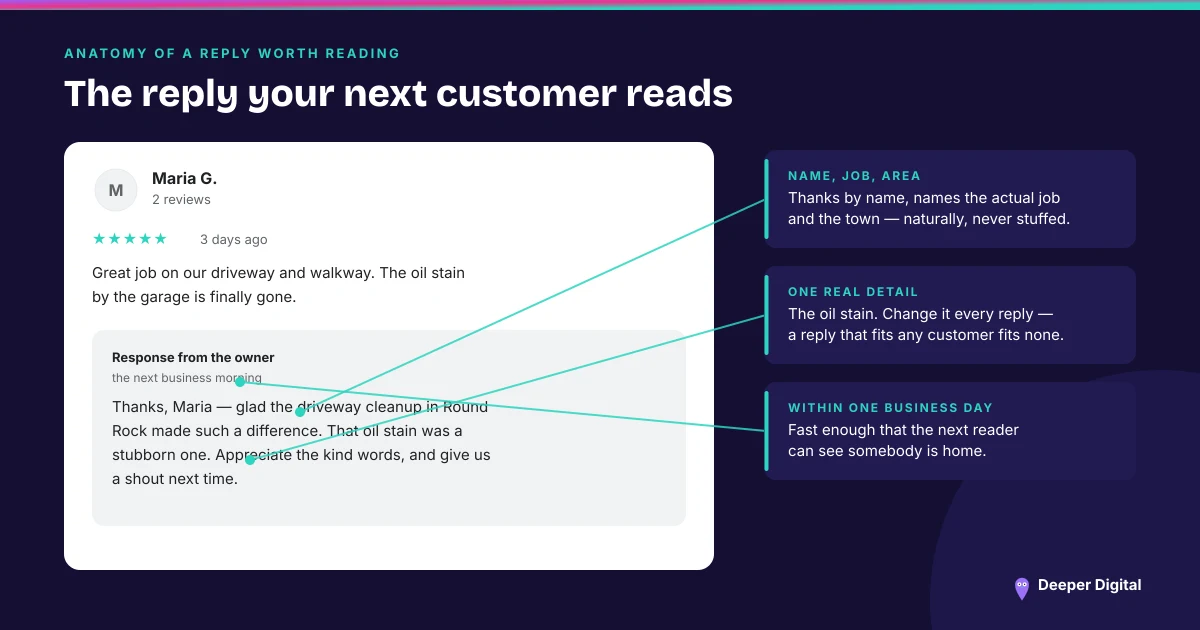
If a customer took the trouble to name someone, the reply should use it. “Thank you — I passed this to Marcus” costs nothing and does two things: it confirms to the reader that Marcus is a real person on a real team, and it hands the employee something worth more to them than most of what turns up in a performance review.
Templates for the rest of it are already written.
Then the person leaves
They will. Detailing, clinics and home care all run on people who move on, and the review does not move with them.
What you can do, in order:
- Nothing to the reviews. They are a dated record of something that happened, and readers understand them that way
- Correct the staff page the same week — a page naming someone who left is not nostalgia, it is a factual error a customer discovers at the counter
- Update booking, voicemail greetings and anything that lets a customer request that person by name
- Stop using their name in current marketing
For clinics this is sharper than elsewhere, because who performs the treatment is a published fact that patients specifically check.
The quiet hedge
If every named review names the same person, you have built a reputation for an employee. That is fine while they are here and thin when they are not.
The correction is not to suppress anything. It is to make sure the ask goes out after every job, from every technician, every week — so that over a year the names spread across the team on their own. A review profile with four names in it survives one resignation. One with a single name is a reputation with a notice period.
Ask every customer, reply using the name they gave you, and fix your staff page the week anything changes. Every review answered, on every plan, is part of what we run.
 NASP
NASP  Wild Foods Co.
  Noble Origins
  Cowboy Pools
  BT Biltong