Google’s review form no longer starts with a blank box. Before or alongside the text field, many businesses now get structured questions — most commonly, which services the customer received and how they would describe the price they paid — with option lists Google supplies. The customer taps answers. Those answers become tags on your profile, and they are read by people who will never open a single review.
Most owners have never seen the screen. It only appears when you go to write a review of someone else, which is not a thing you do on your own listing.
The question set is decided by your category
You do not get questions because you earned them. You get them because your primary category has them attached.
Whitespark published a manual study of 765 businesses across 180 keywords on 6 August 2026, and the split it reported is stark: only about a quarter of the primary categories examined showed review questions at all, and the whole dataset contained around 40 distinct questions. Restaurants and hotels get the rich set — as many as fourteen questions in a single form. Contractors, clinics and most service businesses get the thin one, usually built from the same two: which services did you get, and how would you describe the price you paid.
So the first thing to do is not a task. It is a lookup. Open your own profile as a customer would, tap through to write a review, and read what Google asks. Then do it for the two businesses above you in the pack, whose categories may not be the same as yours.
The service checklist is Google’s picture of your business
The interesting half is not the question. It is the option list underneath it.
When Google asks which services a customer received, it offers a set of choices, and that set is Google’s own working model of what a business in your category provides. It is the same vocabulary that shows up as suggested services in the profile dashboard. Read as a document, it tells you which of your services Google already understands as belonging to you — and which of the things you actually sell are missing from its list entirely.
That gap is worth acting on, because it is the same gap that shows up in your services section on the profile. A service Google has no name for is a service you have to spell out yourself, in your own words, in the places you control.
Wording the ask around the questions, without writing the review
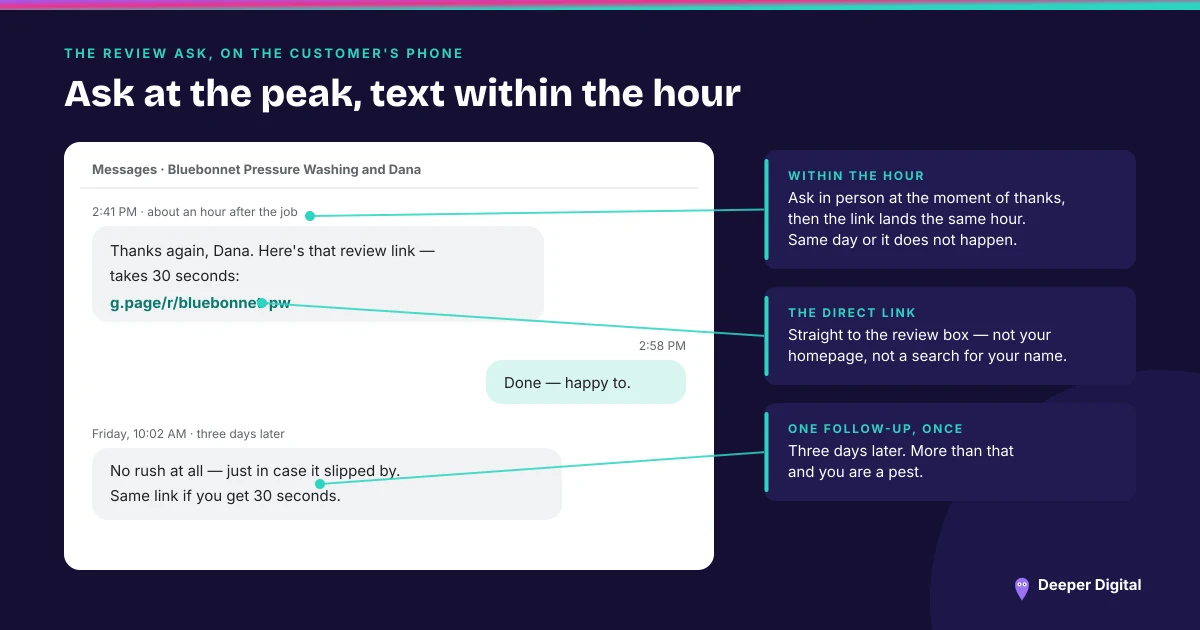
Here is the line, and it matters more than the tactic: you can choose which topics you invite a customer to talk about. You cannot choose what they say.
If your category’s questions are about services and price, then an ask that says “if you have a minute, it would help to know which service you booked and how the visit went” is aimed at the same subjects Google is already asking about. An ask that says “please mention our competitive pricing” is scripting, and it is the thing that gets reviews pulled and profiles flagged. The first is a prompt about a topic. The second is a sentence you wrote and someone else signed.
Our own review reply templates work the same way — a structure to react inside, never a script to hand over. And the timing of the ask still does most of the work: a steady trickle of recent reviews carries further than a burst, for the reasons in review velocity.
Re-check it quarterly
Google changes these question sets without telling anyone, and the change lands at the category level, so it can arrive on a Tuesday for every med spa in the country at once. A profile whose service list was aligned to the question set in March may be misaligned by September and look identical in every report you run.
Put the lookup on a quarterly loop with the rest of the profile check. It takes about four minutes and it is the only way you will notice.
What this does not do
Answering these questions is not a ranking lever, and nobody has shown that it is. What it does is change what a stranger sees in the two seconds before they decide whether to read anything: a set of tags describing what you actually do, generated by people who paid you.
If you want the profile checked properly — categories, services, and the ask system that keeps reviews arriving — that is what the plans on the services page cover. Every review answered within one business day is on the card. Writing your customers’ reviews is not, and never will be.
 NASP
NASP  Wild Foods Co.
  Noble Origins
  Cowboy Pools
  BT Biltong