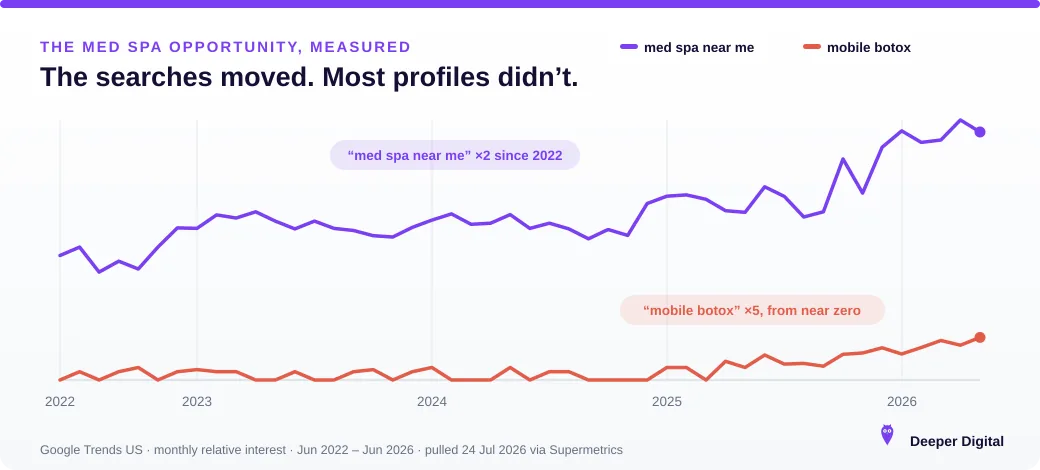
There are two people typing med spa searches this week and the marketing usually only speaks to one of them.
The first has never had a treatment. They are searching in plain language, cautiously, mostly trying to establish whether this is a legitimate place. Nearly every clinic’s content is written for them.
The second has been going somewhere for two years and has decided to stop. They know the vocabulary, they know what they want, and they are considerably harder to convince — because they are not being asked to try something new, they are being asked to give up a routine that mostly worked.
Their query looks different on the page
A first-timer describes a result. A returning patient names a thing: a product, a device, a treatment, sometimes a provider type, usually plus a city.
Those two shapes are answered by different content. The plain-language search wants a page that translates. The named search wants the specific term listed somewhere it can be matched, which is normally the services section of the profile and the corresponding page. The words patients use and the words clinics use are not the same set, and a clinic that only publishes one of them is invisible to half the demand.
What they are actually checking
People rarely leave a clinic over the treatment itself. They leave over the things around it — the appointment that moved twice, being seen by a different person each visit, a consultation that felt like it lasted four minutes.
Which means the record they read is not about results. It is about consistency, and it is entirely visible:
- Do the reviews mention the same people over time, or a different name every month
- Are negative reviews answered, and answered like an adult
- Is it possible to find out who works there and what they are qualified to do
- Does the clinic say anything about who a patient will see on a second visit
That third one is the one cautious patients check first, and who performs the treatment is a publishable fact about your own staff rather than a claim about anything.
Continuity is the objection
The real hesitation is rarely stated out loud, and it is not price. It is that they are in the middle of something. A course of treatment, a schedule they have settled into, a set of notes somebody else holds.
The questions that follow from that are practical and answerable in writing: what a first appointment involves for someone already being treated, whether records or history are discussed, what happens if their timing is due in three weeks rather than three months, whether the same product line is available.
A clinic that answers those in published text is doing something more useful than any offer. It is removing the reason to put the decision off, which is what this patient actually does instead of switching.
The line you do not cross
None of this is a licence to write about the clinic they are leaving.
Comparative claims about another provider’s care are a legal and professional risk, not a marketing tactic, and the risk is identical whether the claim is on a page or dropped into a review reply. The correct move is duller and works better: publish accurate, specific, verifiable facts about your own clinic and let the reader draw the conclusion. That is also the standard every piece of clinical content should meet before it goes live — written with the clinic’s own licensed provider signing off on it.
What to add first
Read your services list against the terms an experienced patient would type. Then read your staff information the way somebody would who has just been let down by a clinic that kept changing who they saw.
Most clinics find the same two gaps: the named terms are missing from the profile, and there is nothing published about who a patient will actually see.
Start with the services list and the staff information — those are the two pages this patient reads. Keeping the profile, services and reviews current is the ongoing work on the clinic side.
 NASP
NASP  Wild Foods Co.
  Noble Origins
  Cowboy Pools
  BT Biltong