A daughter in Denver is arranging care for a father in Killeen. She has two hours before a meeting, a browser tab, and no ability to drive anywhere.
This is not a rare case. In home care the person who searches, decides and pays is frequently not the person receiving the service, and frequently not in the same state. Almost everything written about local search assumes the searcher is standing near the business. This searcher is not, and it changes both halves of the problem.
Her search is shaped by the fact that she has to name the town
A resident types “home care” and lets Google work out where they are. Someone four states away cannot do that. The town goes in the query, every time — home care in Killeen, caregivers Belton TX, in-home care Temple Texas. Which means the town is the market: being findable in Temple and being findable in Killeen are two separate jobs, 25 miles apart.
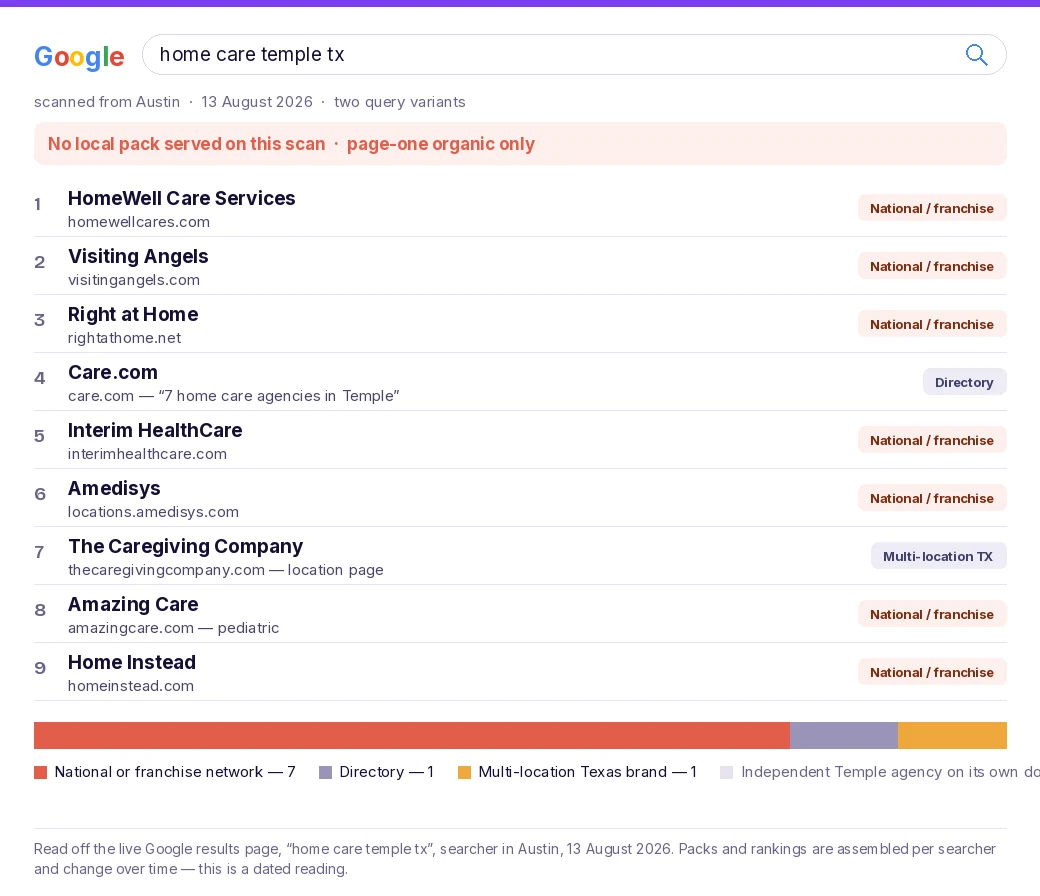
That has a consequence worth sitting with. Her results are assembled around her location, not her father’s, so what Google shows her is a thinner, less local-feeling page than the one a neighbor would see. On our scan of home care in Temple on 13 August 2026, made from outside Temple, Google returned organic results with no map pack at all — and the organic page belonged entirely to franchise networks and directories, with no independent Temple agency ranking on its own website. A family searching from inside Temple may well have seen a pack. She did not.
So the profile is not the whole answer for her. The pages are.
What she can actually assess
Strike out everything she cannot do. She cannot walk in. She cannot meet a caregiver. She cannot ask the neighbor across the fence. What remains is a short list, and it is the entire basis of a decision worth tens of thousands of dollars:
- Reviews, and specifically whether any of them sound like her situation
- The replies to those reviews, which tell her how the agency behaves when something goes wrong
- Whether the towns she cares about are named anywhere
- License and credential information she can verify herself
- Whether somebody answers the phone in a Denver-evening, Texas-night window
- Whether the cost question is addressed in writing at all
That list is short because distance made it short. Every item on it is published, and every item on it is within reach.
The review that does the most work here
Not the five-star one about excellent service. The one written by somebody who was also far away.
“I live in Ohio and they kept me updated every week” is worth more to this reader than a dozen generic compliments, because it is evidence about the exact thing she is afraid of. Home care reviews are written by families rather than clients, which means you can ask the family members who were remote to say so — not what to write, just to mention where they were.
The phone call that follows
She will call, and she will call from a different time zone, and the call is the whole audition. Who answers the phone is the least glamorous item in local marketing and it decides more home care inquiries than anything on the profile does. A voicemail at 7pm Central is 6pm to her, in the middle of the only free hour she had today.
Three things to check this week
Read your own site the way she reads it. Does any page name the actual towns? Is there a sentence anywhere about how families are kept informed at a distance? Does a stranger with no local knowledge learn what a week of care costs, even as a range?
None of that requires new claims. It requires publishing facts you already know to a reader who has no other way to learn them.
Ask your next three inquiries where they were calling from — the answer usually surprises owners. Getting the profile, the service area and the reviews right for the family that cannot visit is what an agency plan keeps current.
 NASP
NASP  Wild Foods Co.
  Noble Origins
  Cowboy Pools
  BT Biltong