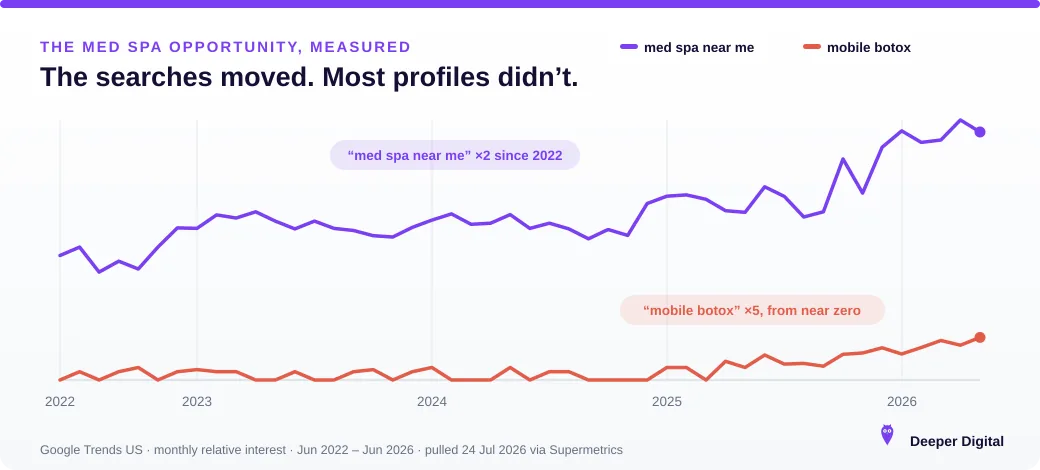
Open the services list on most med spa and wellness clinic profiles and you will find a column of proper nouns. Platform names, device families, the trademarked name of a handpiece. Every one of them is accurate, and most of them are being searched by almost nobody.
The patient typing at nine in the evening is not naming the equipment. They are naming the thing they want to stop having, or the part of themselves they are thinking about, in ordinary words.
Two vocabularies for the same appointment
There is the clinical and commercial vocabulary — the platform, the wavelength, the branded protocol. And there is the patient’s, which is short, plain, and often not a treatment name at all.
The gap is widest on device treatments, because that is where the industry’s own marketing is most brand-led. A clinic can spend years learning to say the platform name correctly and never write down the four words a patient actually types.
Both vocabularies are legitimate. They simply belong in different fields.
Where the plain words go
In the name of the service entry. That is the string being matched and the string being read, and it should be the wording a patient would recognize without explanation: laser hair removal, skin resurfacing, treatment for facial redness, tattoo removal.
Body area is part of that vocabulary too, because patients search it that way — the area and the treatment together, far more often than the treatment alone.
Where the device name earns its place
Inside the description of the entry, and on the treatment page.
There is a real audience for the brand name. It is a patient who has already had the treatment elsewhere, or researched it thoroughly, and is now looking for a provider who has that specific platform. They are a small group and a decisive one, and naming the device is how you are findable to them.
That is the whole case for it, and it is a good one. It is just not a substitute for the plain words, in the same way that the industry’s own term for a med spa is worth covering without being adopted as an identity.
One sentence per entry, and no claims in it
A service entry needs the treatment named as patients say it, and one plain sentence about what the appointment involves — length, whether a consult comes first, what someone should expect to do afterward.
What it must not contain is a claim about results. Not a number, not a duration of effect, not a comparison to another clinic’s equipment. A profile field is a poor place to make a clinical claim and an excellent place to have one quoted back at you, and anything with clinical wording in it should be signed off by the licensed provider responsible for that service before it goes live. That is the standard we hold our own med spa work to, and it is not a formality.
The consult is the conversion, so say how it works
For most device treatments the next step is not a booking, it is an assessment. Patients know this and it is one of the things they are trying to establish before they call: whether the first visit costs anything, how long it takes, and whether they will be sold to.
Answer that in the description and in the Q&A. It is the same principle as answering the payment question before it is asked — the clinic that has already answered the practical question is the one that gets the call, because the alternative is a phone call to find out.
The wider pattern is covered in how patients search for injectables: outcome first, area second, brand a distant third. Device treatments follow the same order, and the full profile setup for a med spa is where it gets applied.
Read your services list and ask whether a patient would recognize each entry without a search of their own. Rewrite the ones that fail, put the device name in the description, and have the provider check the wording. Building that list out properly is part of what we set up for clinics.
 NASP
NASP  Wild Foods Co.
  Noble Origins
  Cowboy Pools
  BT Biltong