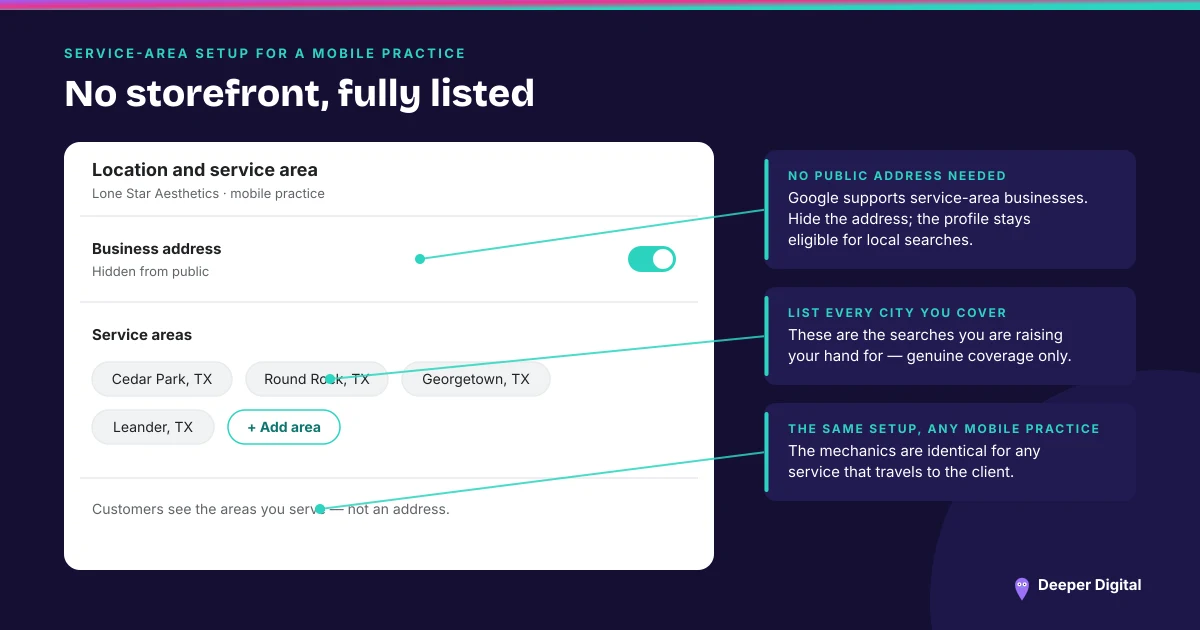
A mobile IV therapy practice sets up its Google Business Profile by verifying at a real address, hiding that address from public view, and naming the cities it actually serves. That part is the same as any mobile business. What is not the same is the scrutiny: there is no storefront to look at, and the service is regulated. The profile is the only evidence the business exists, so it gets read carefully. The four things that draw a second look are all fixable before you submit.
Name it what it is called
The name on the profile is the name of the business: the one on the license, the LLC filing, the invoices and the side of the vehicle. Not the name plus the city, and not the name plus a service term.
This is the most tempting shortcut in local search and the one with the worst return. Google’s guidelines are explicit that the profile name is the real-world name, and a name built for searches rather than for reality is among the most commonly reported reasons a profile disappears. The searches are won by the categories and the services, which is where they were always meant to be won.
Have a real address, and hide it
Verify somewhere real: a clinic, an office, a home. Then clear it from public view, because patients do not come to it. That is Google’s stated rule for service-area businesses, not a workaround, and the mechanics are the same for any mobile operation. (The full service-area setup, step by step.)
What does not survive is a borrowed address: a coworking suite you visit monthly, a registered agent’s office, a mailbox. For a practice with no public premises, an address that cannot be corroborated is the weakest point on the whole profile.
Categories that describe the practice, not the ambition
There are categories for IV therapy and there are broader categories for clinics and in-home care. The primary category should be the one a patient would use to describe you, not the widest one you are arguably eligible for. Secondary categories carry the rest. (Primary versus secondary, and what each one does.)
Then the services list, in the words patients use, priced or not priced as you prefer. (How the services list works.) Anything clinical in that list or in the description is the responsibility of the provider who signs off on it. Write it, then have them read it before it goes live.
Assume you will be asked for video
Google may ask for an unedited video showing that the business is real and that you are authorized to manage it. For a mobile practice that generally means the vehicle, the supplies and equipment, licensing documentation, and something tying you to the business.
Nobody controls how that review goes. What you control is arriving prepared: gather it before you start rather than during, and record once. If a profile does get taken down, the cause matters more than the appeal, and the cause is usually one of the four things above. (What actually gets a suspended profile back.)
One consistent story
The profile, the website, the license and the vehicle should all name the same business in the same words. A reviewer comparing them is the entire test, and consistency is the only thing that passes it reliably.
The short version
Real name, real address hidden, honest categories, provider-approved services, and the video evidence gathered before you need it. Set once, deliberately.
Getting a mobile practice found starts with a profile built to hold up. That setup, and keeping it current as your coverage changes, is the monthly work. See local SEO for wellness clinics, or read how IV therapy demand actually shows up in search.
 NASP
NASP  Wild Foods Co.
  Noble Origins
  Cowboy Pools
  BT Biltong