Home care agencies rank beyond their office town with one substantial page per town they genuinely staff. That is the whole line between coverage and spam. The office sits in one town, but the caregivers drive. You might serve eight towns and rank in exactly one: the one on your address.
Service area pages are the fix. They’re also one of the fastest ways to damage a site, and the gap between the two versions is narrower than most agencies think.
Why does the office address limit you?
Proximity is a real ranking factor in the map pack. A family searching in a town twenty minutes from your office sees the agencies near them first, whether or not those agencies are better.
You can’t fix that with the profile alone. What you can do is give your website something to rank for in each town you actually serve. That’s what a service area page is. (The agency website fundamentals.)
What separates a useful page from a spam page?
One test: could this page have been written about anywhere else?
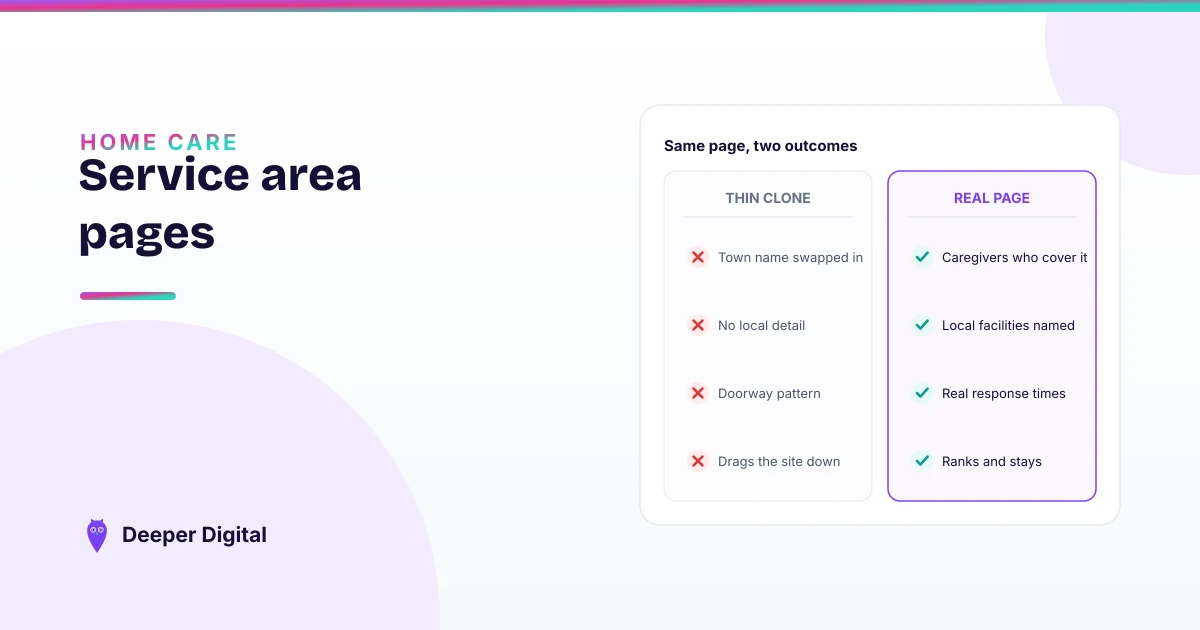
If the only difference between your Georgetown page and your Round Rock page is the word Georgetown, that’s the doorway pattern, and search engines look for it specifically. It doesn’t just fail to rank. It can drag down the pages that would have.
A legitimate town page contains things that are only true of that town:
- Which of your caregivers actually cover it, and typical response time
- The hospitals, rehab facilities and senior communities you coordinate with there
- The neighborhoods and roads you genuinely reach
- Anything specific about serving that area: parking, gated communities, rural drive times
That’s not SEO padding. The family wants that information anyway.
How many pages should you have?
Exactly as many towns as you can genuinely staff. The number is set by your coverage, not your ambition.
Six substantial pages for six real towns will outperform thirty thin ones every time, and won’t put the rest of the site at risk. If you can’t say something specific and true about a town, you’re not ready to have a page for it. (The same discipline applies to the profile’s service area settings.)
Should you make a page for a town you’re hoping to enter?
No. It generates inquiries you have to decline, which wastes a family’s time during a stressful week, and it’s precisely the pattern that gets local pages devalued.
Add the page when you can staff the town. The order matters.
What should each page actually contain?
A workable structure:
- A specific opening. Who you serve in this town and how quickly you can start.
- Services, named. Dementia care, post-surgical, overnight, respite. Same services, described in the context of that area.
- Local coordination. Facilities and providers you work with nearby.
- Practical coverage detail. Response times, neighborhoods, anything unusual about serving there.
- Proof. Reviews from families in or near that town, where you have them (how to get more of those).
- One clear way to call.
Google’s guidance on helpful, people-first content is the standard these need to meet. It’s stricter than it used to be.
Do these pages help with AI answers too?
Yes, and people underrate this part. When someone asks an assistant “what home care agencies serve [town],” it needs a source that plainly states you serve that town. A page that says so, with specific local detail, is far more quotable than a homepage listing a metro area. (How assistants pick which businesses to name.)
Service area page checklist
- One page per town you genuinely staff, and no more
- Something on every page that could only be true of that town
- Named services, described in that area’s context
- Local facilities and coordination detail
- Reviews from that area where you have them
- Consistent name, address and phone throughout (why)
- No page for a town you can’t serve yet
The honest shortcut
Town pages are part of the 8 blog posts a month. The plan also runs everything underneath them (profile, reviews, listings) every week. See the service, or grab a free game plan and we’ll map which towns you could realistically staff first.
 NASP
NASP  Wild Foods Co.
  Noble Origins
  Cowboy Pools
  BT Biltong