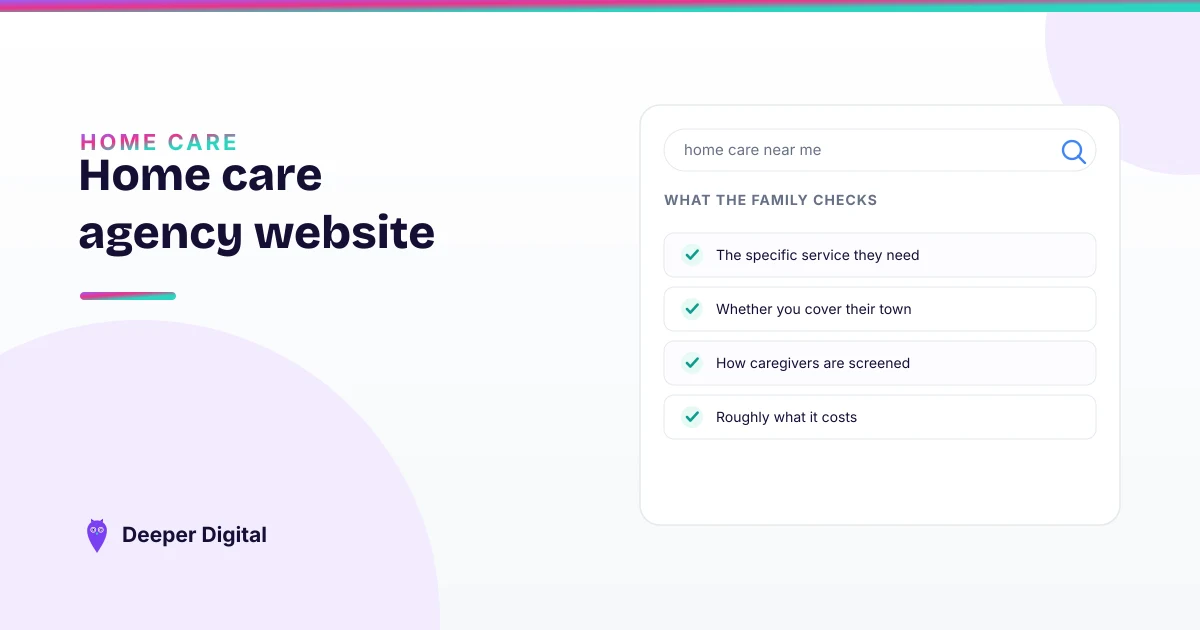
Families check four things on a home care agency website before they call: the specific services, the exact towns covered, how caregivers are screened, and roughly what it costs. The person doing that checking is usually not the person receiving the care. It’s an adult daughter, at eleven at night, three states away, who found out this week that her father can’t manage the stairs anymore.
She is going to look at four or five agency websites in about twenty minutes. What she’s looking for is narrow and specific, and most home care sites don’t have it.
What is she actually checking?
Four things, roughly in this order:
Do you do the specific thing my parent needs? Not “compassionate care.” Bathing assistance, dementia care, post-surgical support, overnight coverage, hospice support. She has a specific problem this week.
Do you cover my parent’s town? Not the metro. The town. If she can’t confirm it in ten seconds she moves on.
Who are these people and how do you check them? Background checks, training, supervision, what happens when a caregiver calls out. She’s about to give a stranger a key to her father’s house.
What does it cost, roughly? Not a precise quote. A structure: hourly, minimum hours, whether overnight differs. Sites that hide this entirely read as expensive.
Most agency sites answer none of the four above the fold. They open with a stock photo of a smiling older couple and a paragraph about a mission. (The wider home care marketing playbook.)
Why does the site matter if the profile is strong?
Because they do different jobs. The Google Business Profile gets you found. The website is where she decides whether to call.
The sequence is nearly always the same: search, map pack, profile, website, reviews, call. A strong profile with a thin site behind it loses to the agency that has both. She got to the site and it didn’t answer her questions.
The site is also what AI assistants read when someone asks “what home care agencies serve [town].” Profiles tell them you exist; pages tell them what you actually do. (How AI assistants decide who to name.)
How should the pages be organized?
One page per service, one page per town you genuinely serve. That’s the structure that matches how people search: “dementia care [town],” not “home care services.”
The critical word is genuinely. Building forty near-identical town pages by swapping a name into a template is a well-known spam pattern. A page for a town you actually staff, with real detail about that area, is an asset. Forty thin clones are a liability that can drag the whole site down. (How to do service area pages without tripping that wire.)
What about caregiver credentials?
Put them on the site in plain language, because this is the thing that converts. Background check process. Training requirements. Whether caregivers are employees or contractors (families increasingly know to ask). Who supervises, and what happens at 6am when someone calls out sick.
Agencies tend to under-sell this because it feels like table stakes internally. To the daughter, it’s the entire decision. (And it’s the same thing your reviews should be reinforcing.)
Should you publish pricing?
Publish the structure, even without the number. “Hourly, four-hour minimum, overnight and live-in rates differ, most families we work with are in this range” is far more useful than silence, and it filters out the inquiries you can’t serve anyway.
Total silence on cost signals expensive, and she’ll call the agency that gave her something.
What about the technical side?
Keep it boring and consistent. Name, address and phone identical to your profile and everywhere else you appear (why that consistency matters). Fast enough on a phone, because she’s on one. A phone number that’s tappable. Google’s own guidance on helpful content is the honest reference for the rest.
Home care website checklist
- Specific services named, not “compassionate care”
- Every town you serve, listed and confirmable in seconds
- Screening, training and supervision explained in plain words
- Cost structure given, even without an exact number
- One real page per service and per town, never thin clones
- Name, address and phone identical to your profile
- Fast and tappable on a phone
The honest shortcut
Your website is built, hosted and written on the plan, with 8 blog posts a month on top. And we run the step before it: the profile she finds first, and the reviews she reads there. And you own everything we build. See done-for-you local SEO for home care, or grab a free game plan.
 NASP
NASP  Wild Foods Co.
  Noble Origins
  Cowboy Pools
  BT Biltong