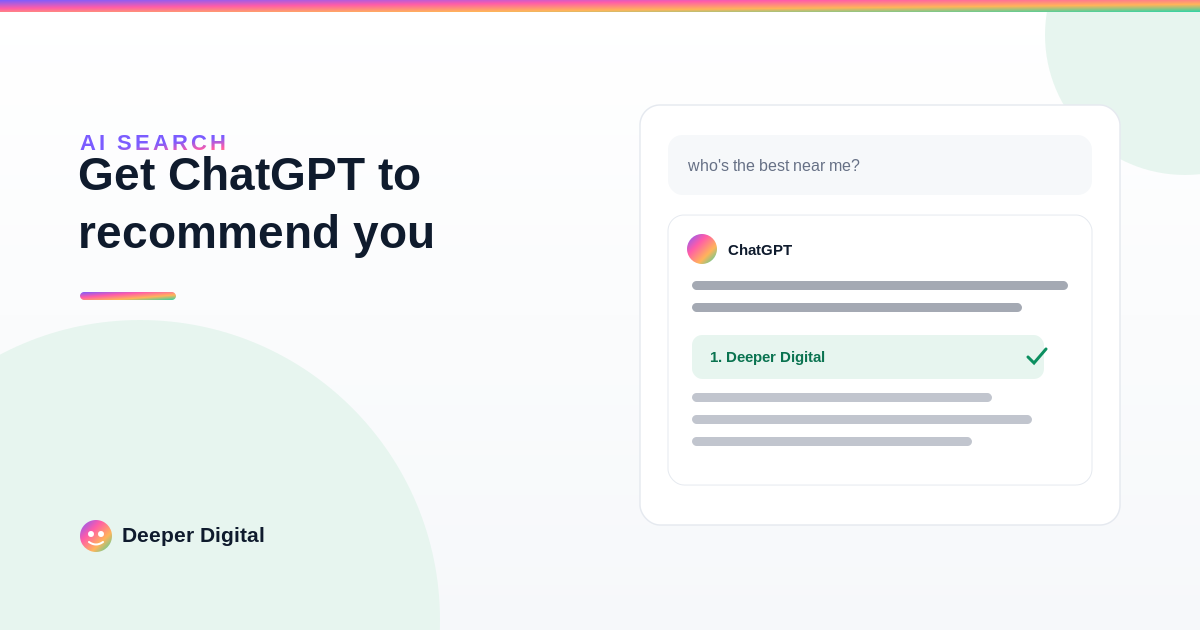
“Who’s a good pressure washer near me?”
A year ago that question went to Google. Now a growing slice of it goes to ChatGPT and Gemini — and they don’t show ads or ten blue links. They name two or three businesses.
Either you’re one of the names, or you don’t exist in that conversation.
How does ChatGPT decide which local businesses to recommend?
AI assistants pull from the same public record Google reads: your Google Business Profile, your website, your reviews, and mentions of your business across the web. They synthesize all of it and name the businesses that look established, specific, and well-reviewed. There’s no separate “AI SEO” trick — the assistants are reading the same homework, just grading the whole notebook at once.
That’s good news. It means the work is knowable.
What do AI assistants actually read?
Four sources, in rough order of weight for a local service business:
- Your Google Business Profile. Category, services, service areas, hours, review count and content. A complete profile with the right categories is as foundational for AI answers as it is for the map pack.
- Your reviews — the words, not just the stars. Assistants quote review language. “They cleaned our roof without wrecking the flower beds” can literally become the reason you’re recommended for roof cleaning. Steady, detailed reviews are AI fuel — here’s the system.
- Your website. Plain pages that say what you do, where you do it, and what it costs. Assistants love pages that answer questions directly — a real FAQ beats a wall of marketing speak.
- Everywhere else you’re mentioned. Directories, local news, supplier pages. Consistent name-address-phone across all of them tells the machine you’re one real business, not a maybe.
How is this different from regular local SEO?
Mostly it isn’t — and that’s the insight most agencies are missing. The same substance that ranks you on Maps gets you named by AI. The differences are emphasis:
- Written specifics beat everything. AI can’t recommend you for gutter cleaning if the word “gutter” appears nowhere on your profile or site. Every service you offer needs to exist in words, not just in your truck.
- Question-shaped content wins. Assistants lift direct answers. A page that plainly answers “how much does pressure washing cost in Texas?” is exactly the kind of thing that gets quoted.
- Trust language compounds. Years in business, insured, response time, guarantees — assistants weigh “safe recommendation” signals heavily, because being wrong embarrasses them.
Can I test where I stand right now?
Yes, in five minutes. Open ChatGPT (and Gemini) and ask, as a customer would: “Who should I call for [your service] in [your city]?” Three outcomes:
- You’re named. Screenshot it, then protect the position — the inputs above decay if unmaintained.
- Competitors are named, you’re not. Their public record is more complete than yours. Fixable.
- The assistant hedges with generic advice. Nobody in your market has claimed the answer yet. First mover takes it.
We run this test for our own profile monthly and log the results in public on the results page — it’s also a line item in every analysis we send.
The move most owners won’t make
AI recommendations are compounding and quiet: no ad auction, no leaderboard, just the assistants slowly settling on who the “safe answer” is in each market. The businesses doing consistent profile work now are writing that answer before their competitors know the question exists.
For the step-by-step version, work through our AI search checklist for local businesses, see how Gemini picks local businesses, and if you’re wondering how much your reviews feed those AI answers, we dug into exactly that here.
Want to know what ChatGPT says about your market today — and what’s keeping you out of the answer? Free analysis, no card. We include the AI-visibility check with every one, and maintaining it weekly is literally our job.