Yes — AI assistants use your Google reviews, but not the way a lot of people assume. When a customer asks “who’s the best detailer near me,” it’s less about the number on your profile and more about what the reviews say and whether your reputation is consistent across the web.
Here’s what we’re seeing, and how to act on it.
Do AI assistants read Google reviews?
Yes, at least indirectly. AI assistants draw on the broader web and on local data sources where your reviews and ratings live.
This isn’t a fringe behavior: BrightLocal’s Local Consumer Review Survey found roughly half of consumers would read an AI-generated summary of reviews alongside the reviews themselves — so the language in your reviews increasingly reaches people through a model, not just directly. A business with a strong, recent set of reviews reads as a safer recommendation, so it’s more likely to be named.
But an assistant doesn’t count stars. It reads what people actually wrote, checks whether the story is consistent across the web, and decides if you’re a safe name to say.
Is a higher review count enough to get recommended?
No. Volume alone doesn’t decide it. Review count gets sold hard because it’s the easiest number to put on a chart, and it isn’t the number doing the work. A profile with two hundred vague “great job!” reviews can be less useful to an AI than one with forty reviews that name specific services, places, and outcomes.
The model is trying to answer a specific question — “good mobile detailer in Waco” — and reviews that mention detailing and Waco help it far more than a big undifferentiated pile. This mirrors what we already know from normal ranking: reviews are roughly a fifth of the local picture, not the whole thing.
What kind of reviews help most with AI search?
Reviews that read like evidence:
- They name the service (“ceramic coated our truck”)
- They name the place (“in Cedar Park”)
- They describe a specific outcome (“got out a stain two other companies couldn’t”)
- They’re recent, so the reputation looks current
You can’t script customers, but you can prompt them. When you ask for a review, gently suggest they mention what you did and where — most people are happy to when nudged.
Do bad reviews hurt me more with AI?
They factor in, but a handful of negative reviews among many good ones isn’t the problem — how you handle them is. A thoughtful public reply to a bad review is part of your reputation signal, and it’s visible to both people and models.
Here’s how to reply to reviews without making things worse. Silence next to a bad review is the weaker look.
What should I actually do about it?
Nothing exotic. Keep a steady flow of real reviews, prompt reviewers to name the service and area, reply to every one, and keep your business information consistent everywhere so the reputation an AI assembles about you doesn’t contradict itself.
That’s the same review system that already helps you in normal search — it just pays off twice now. It also lines up with the broader AI search checklist and the full playbook for getting ChatGPT to recommend your business.
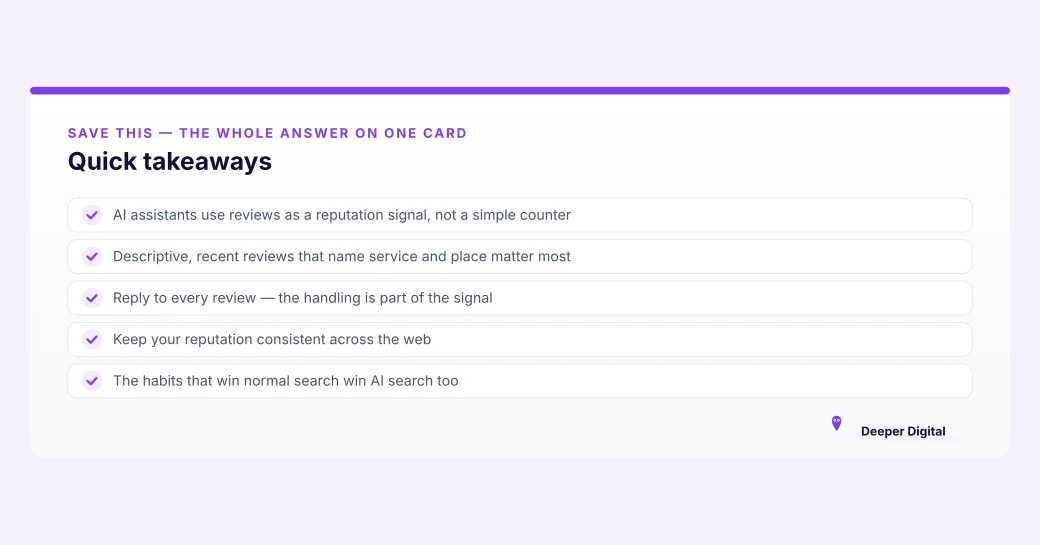
Quick takeaways
The short version: AI assistants treat reviews as evidence of reputation — and descriptive, recent, well-handled reviews are what get you named.
- AI assistants use reviews as a reputation signal, not a simple counter
- Descriptive, recent reviews that name service and place matter most
- Reply to every review — the handling is part of the signal
- Keep your reputation consistent across the web
- The habits that win normal search win AI search too
Reviews are one lever among several. Answering every single one — and asking for the next after every finished job — is on every plan. Here’s the ladder. And if you want to know how your reviews read to a model today, a free game plan is here.
 NASP
NASP  Wild Foods Co.
  Noble Origins
  Cowboy Pools
  BT Biltong