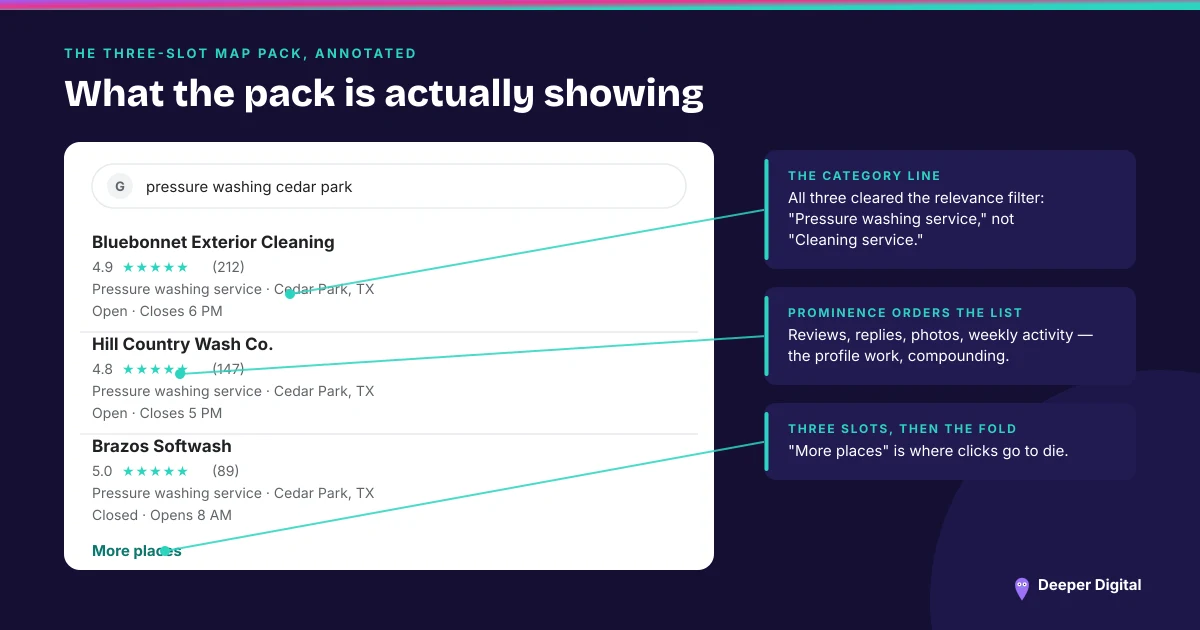
You have checked the same search for two years. This week there is a name in it you have never heard of, and you are one place further down.
The sequence that usually follows is: check it again, check it from your phone, look up the competitor, decide they are cheating, and spend an afternoon on it. Only one of those steps is useful, and it isn’t the last one.
First, establish that anything happened
Local results are assembled around the searcher’s location and they move on their own. Two readings from your own shop floor, on two days, are not a comparison — searching your own business name from inside the building is the least informative test available to you.
Before treating this as an event, check the same query from a location that is not your desk, and check it more than once across a week. If the new profile is holding a seat across several readings from several places, it is real. If it appeared on Tuesday and is gone by Friday, you have watched the weather.
Second, work out which kind of competitor this is
There are three, and they need completely different responses.
A real business that opened. Somebody leased a unit, hired people, and started collecting reviews. Nothing has been done to you. This is the most common case and the least satisfying one.
A real business that just got competent. They have existed the whole time and someone finally filled in the profile — categories corrected, services listed, photos added, reviews being asked for. This is the case that should sting, because the gap it exposes is one you could have closed at any point.
A profile that should not exist. A virtual office, a name stuffed with keywords, a category the business does not practice, an address that turns out to be a house with no signage. This one has a route, and it is reporting a spam listing — a narrow route for a narrow set of facts.
Working out which of the three you are looking at takes about ten minutes and decides everything you do next. Most people skip it and go straight to the response for the third case.
Third, resist the two bad moves
Reporting a legitimate competitor is not a service Google offers, and the attempt costs you the afternoon.
Editing your own profile in a hurry is worse. Adding a keyword to your business name, widening a service area to places you do not serve, adding categories for volume rather than accuracy — each is a documented cause of suspension, and a suspended profile is not fourth, it is absent. The panic response to losing a position is capable of losing you the whole profile.
What the new arrival is actually telling you
Something in the local set of inputs shifted, and one of them shifted in their favor. Age is not one of those inputs, which is the part established owners find hardest to accept. The list is public and short: category match to what was typed, proximity to the searcher, review volume and recency, profile completeness, listings that agree with each other.
Take an honest reading of the new competitor against that list. Nine times out of ten they are ahead on one or two items, and those items are ones you stopped attending to in 2024.
The uncomfortable version
The pack has three seats and does not care how long you have been in business. Being displaced by a two-month-old profile is not an injustice; it is information about what the two-month-old profile has been doing weekly that you have been doing annually. Reviews go stale. Photos date. Categories drift as a business changes what it sells.
If you are now fourth rather than third, that position is worth more than it feels like, and the way back is the same list as everyone’s, done consistently rather than in a panic week.
Take one honest reading against the public list of inputs before you touch anything on the profile. Running that list every month — categories, photos, reviews answered, listings consistent — is what the plans are for.
 NASP
NASP  Wild Foods Co.
  Noble Origins
  Cowboy Pools
  BT Biltong