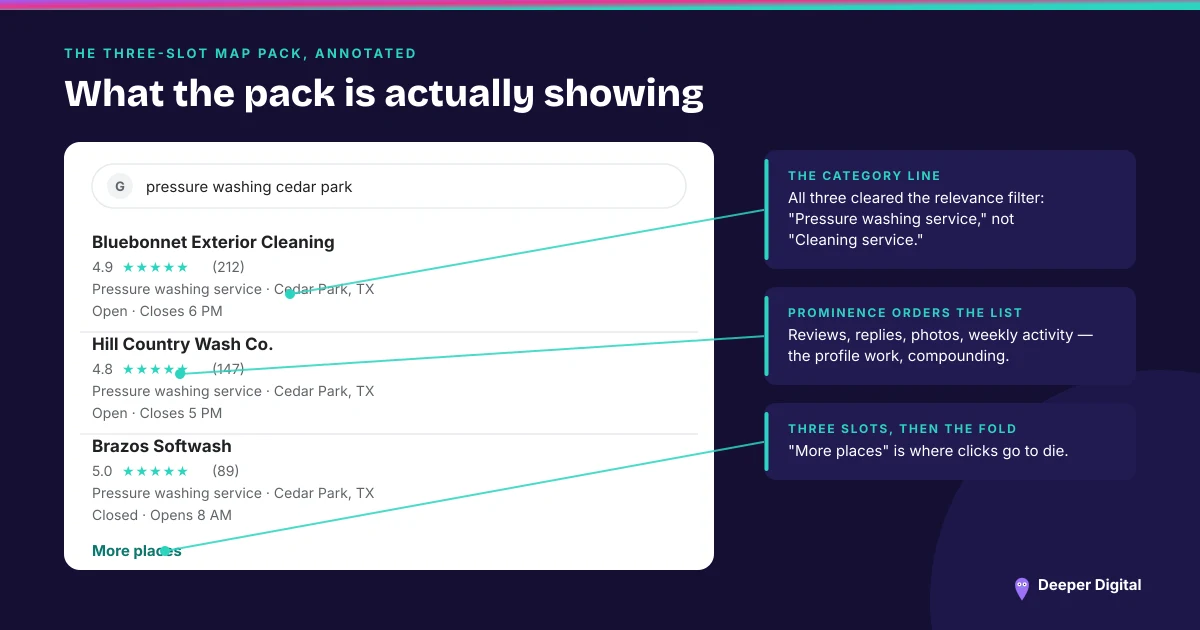
Searching your own business name from your own phone is the least reliable ranking check available. Google assembles a local result around the searcher (where they are, whether they are signed in, what they have looked at before), and you are the searcher whose signals point hardest at your own business. To read your position honestly, you have to fix the location and take the date down with the answer.
Why does my own search look so good?
Google is not testing you. It is answering the person in front of it, and that person has your address in their saved places and your business in their history.
Two things are moving at once. Location decides which set of businesses are even candidates. Personalization nudges what surfaces inside that set. You cannot switch the first one off, and you can only partly switch off the second.
Does incognito fix it?
Partly. This is the most common misunderstanding in the whole topic. Incognito removes sign-in and history. It does not move you. An incognito search from a desk in Austin is still a search from Austin, and if you sell in Round Rock that answer is not the one your customer sees.
What does location actually do?
Enough to be the whole result. On 13 August 2026 we scanned three Central Texas markets from an Austin browser and got no pack at all for out-of-town queries. On 17 August, running the same style of scan with the search location set explicitly to the target city, a pack rendered on all four attempts. Same tool, same operator, four days apart. The variable was where the search claimed to be.
The two clearest readings from that day are published with their data: the Waco detailing scan, where a business with 110 reviews at a five-star average sat third behind one with 16, and the Corpus Christi mobile IV scan, where a 15-review clinic held seat two ahead of a 38-review one. Neither of those readings exists if you check from the wrong city.
How do you know the location actually took?
You look. Google shows a location chip above the results, and on those scans every SERP was checked for it before any figure was written down.
The caveat that belongs in any honest version of this: even with the location set, the footer still reported a home area back in Austin. The search was located, not relocated. It is a solid reading of that city’s pack. It is not the same thing as a logged-out phone standing on the corner. If someone sells you a rank report without that distinction in it, they have overstated what they measured.
What does a real check look like?
Five habits, none of them technical:
- Set the location explicitly to the market you sell in, rather than accepting where you are
- Sign out, so account history stops contributing
- Run the query a customer would type, not your business name. The name search is a formality you always win
- Repeat on more than one day, because packs move
- Write down the date and the location beside the result
Skip the last step and the reading is unusable a month later, because you will not remember which of the variables it was carrying.
What should you do with the answer?
Treat it as a range and not a score. Position varies across a city block by block; one screenshot is one point on that surface. What the check is actually good for is direction over months, and for spotting the specific competitor you keep landing behind. That’s the useful question anyway. (Why the pack decides who gets the call.)
Want the reading done properly for your market instead of from your own desk? That is what the free game plan is for. Here’s what it contains, in detail.
 NASP
NASP  Wild Foods Co.
  Noble Origins
  Cowboy Pools
  BT Biltong