Nobody plans this search. A date gets set by somebody else, and a family that had not been thinking about home care that morning is suddenly arranging it for the day after tomorrow.
Everything about how they search is shaped by that clock.
What compression does to a search
There is no browsing phase. The family opens their phone, types the situation as they would say it out loud, and works down whatever appears. They are not comparing philosophies of care. They are checking four things, fast: do you cover the address, can you start by the date, roughly what does it cost, and does anyone answer.
An agency that makes any of those four hard to find is skipped without being rejected, which is a distinction that matters only to the agency.
They do not type “home care”
They type the situation. Help at home after hospital. Someone to stay with mom after surgery. Care at home while she recovers. Getting a parent home from the hospital.
This is the same pattern that shows up when families need short-term cover and never once type the word the industry uses for it — the respite version of this problem is the closest relative. The fix is the same: your pages have to contain the sentence the family would say, not only the term on your license.
The distinction they cannot make and you can
A family told their mother needs help at home often cannot tell you whether they need skilled nursing, home health, or non-medical assistance. They have been given words by three different people in two days.
An agency page that states plainly what it does and what it does not — and names the thing they should call instead if it is the other one — converts better than one that hopes the question does not come up. It is also the honest answer. The two-audience version of this, where the facility is being checked by a planner and a family at the same time, works differently and is worth understanding if you sit near that referral flow.
The name lookup after the list
Discharge planners generally hand over a list. The family then looks up the names on it, which means a share of your most valuable traffic arrives as a search for your own agency by name.
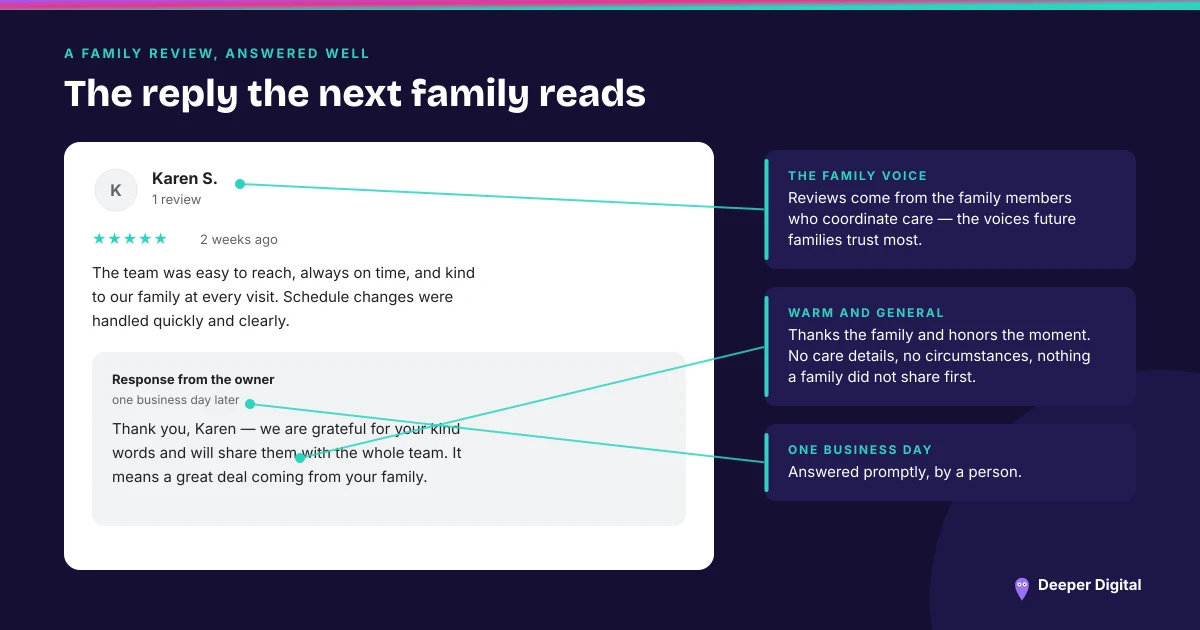
What surfaces there is the profile: the reviews, the replies, the hours, whether the phone number is right. That is a low-effort thing to have correct and an expensive thing to have wrong, because it is being read by someone who was already told you were an option.
What has to be true before the call comes
None of this is fixable in the moment. By the time the family is searching, the profile either answers or it does not:
- The service area actually covers the neighborhoods you serve
- The phone number rings somewhere a person picks up, including in the evening
- Recent reviews exist and have replies
- The cost question is answered somewhere on the site, even in ranges
That last one is the most commonly avoided and the most commonly searched. The money questions families ask — Medicare, Medicaid, VA benefits, long-term care insurance — get typed whether or not you have written anything for them.
Check tonight that your phone number, hours and service area are right, then read your own site for the words a family would use. Keeping the profile accurate, reviewed and answered is the work we do for agencies.
 NASP
NASP  Wild Foods Co.
  Noble Origins
  Cowboy Pools
  BT Biltong