Open almost any detailing profile in Central Texas and you will find the same gallery: twenty finished cars, shot at the same angle, in the same light, at the end of the same kind of day. The work is often excellent. The gallery still says nothing that the profile three seats down does not also say.
The missing photos are not better versions of the ones already there. They are different subjects entirely, and most of them take ten seconds during a job you were doing anyway.
The van, and the setup around it
For a mobile detailer this is the single most under-shot subject, and it is the one that explains the business model without a word of copy.
The van with the doors open. The water tank. The generator running. The mats laid out on a tarp. The lights up on a vehicle at dusk. Someone searching “mobile detailing” is trying to picture what turns up in their driveway, and a photo of a finished sedan does not answer that question — a photo of your rig parked and working does.
If you operate from a bay instead, the equivalent shot is the bay mid-job, not the bay swept and empty.
The middle of the job
Before-and-after is a separate discipline with its own rules, and it is covered on its own terms elsewhere. This is the third state nobody photographs: during.
Foam on the panel. The extractor half through a back seat. Tape along a trim line before correction. Clay in hand. These read as competence in a way a result cannot, because a result is a claim and a process is evidence.
The shelf
Your product wall is a photograph, and an oddly persuasive one.
Not for the brand names, though a customer who knows them will notice. For what the shelf communicates about the difference between a business and a bucket. Same for the polisher, the pad drawer, the extractor, the steamer, the lighting.
Photograph the tools once a year, and again whenever you buy something that changed the work.
The person
A mobile detailer is a stranger who arrives at somebody’s house and spends three hours there. A face on the profile before that happens is worth more than another hood.
One clear shot of whoever does the work, in the shirt they actually wear, next to the van. Not a headshot with a gray background — that reads as a business card and this is a person who is going to be standing in a driveway.
The categories nobody thinks of as photogenic
If you do work beyond cars, that work needs its own images or Google and the customer both assume it does not exist. A boat under a coat of sealant, an RV roof, a motorcycle on the stand. (The non-car markets, and why they need separate entries.)
Same for the interior-only jobs, the headlight restorations and the engine bays. A single photo makes a service real; a services entry with nothing behind it does not.
What to do with the pile
Add a few every month rather than all of them on a Sunday. The tab is dated and the pattern is visible.
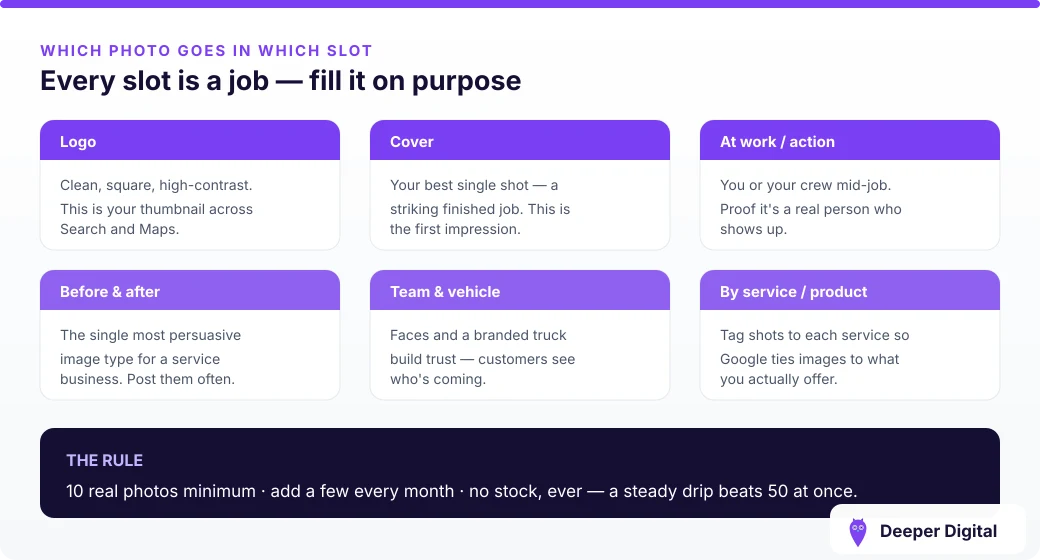
Keep the specs in mind before uploading, because a photo removed for the wrong file type is indistinguishable from a photo Google disliked. (Which slot each image belongs in, and how many.) (What the statuses mean when one disappears.)
And leave the customer out of it. No plates, no house numbers, no faces you did not ask about. The car is the subject and the driveway is a background.
Take the photos during the week — you are already there, and nobody else can shoot your van. Keeping a detailing profile fed with them, month after month, is what we run for detailers.
 NASP
NASP  Wild Foods Co.
  Noble Origins
  Cowboy Pools
  BT Biltong