Reviews are the proof that books detailing jobs. Detailing asks a customer to hand a stranger the keys to the second most expensive thing they own. Nothing on your website settles that. Reviews do. They’re why one shop’s phone rings and the identical shop next door sits quiet.
What kind of review helps?
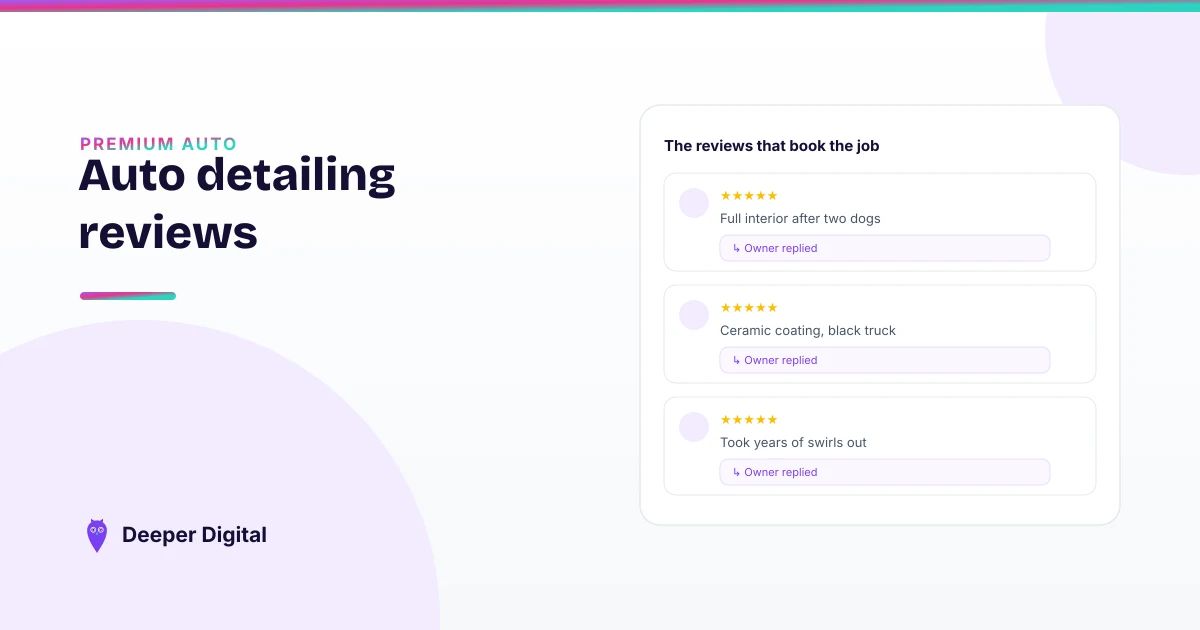
Specific ones. “Great service, highly recommend” is worth very little to the next reader. “Did a full interior on my truck after two dogs and three kids, looks new” is worth a great deal. It tells the next customer their exact situation is handled.
So when you ask, ask for the specific. “If you have a minute, it really helps if you mention what we did on the car.” That one sentence changes what you get. (The general review system.)
When should you ask?
At pickup, standing next to the car. That’s the peak of satisfaction and the moment the result is most visible.
A message three days later is competing with their entire week, and converts far worse. Shops that build the ask into handover get several times the reviews of shops that automate a follow-up and hope.
Make it easy: a QR code on the counter or the receipt, straight to the review form, so it takes fifteen seconds instead of a hunt. (Why this matters for the profile overall.)
Does volume or recency matter more?
Recency, by a distance. A shop with thirty reviews from this year reads as busy and current. Two hundred reviews that stopped in 2023 reads as a business that might not exist anymore, and customers notice the dates.
There’s no magic number to hit. The goal is flow (a few every month, forever), not a total.
What do you do about the unfair one?
Reply once, briefly and factually, and stop. State what happened, state what you offered, leave it.
The reply isn’t for the reviewer; they’ve made up their mind. It’s for the next customer reading it, who is deciding whether you seem like a reasonable person to leave a car with. A calm three-line reply under an angry review often reassures more than the five-stars around it.
What loses work is arguing, going long, or blaming the customer. (Reply patterns that work.)
Can you ask for reviews at all?
You can ask. What you cannot do is pay for them: no discounts, no free upgrades, no raffle entries in exchange for a review. That violates Google’s prohibited and restricted content policy and puts the whole profile at risk, including the honest reviews.
Ask everyone, pay no one. (How to spot the providers who suggest it.)
Do reviews feed AI answers too?
Yes, directly. When someone asks an assistant “best detailer near me,” the wording of your reviews is part of what it reads. Reviews that name services (ceramic coating, paint correction, interior detail) teach the assistant what you do. Generic praise teaches it nothing, and the service words worth teaching it are the ones customers type rather than the ones the trade prints. (How AI assistants use reviews.)
Auto detailing review checklist
- Ask at pickup, standing at the car
- Ask them to mention the specific service
- QR code to the review form on the counter
- Every review replied to, positive and negative
- Negative replies short, factual, unarguing
- Never pay or trade for a review, ever
- Aim for steady flow, not a total
The honest shortcut
Replying to every review, every week, for years, is the part that quietly stops happening. That’s the job we take. See done-for-you local SEO for auto detailing, or grab a free game plan and we’ll count the unanswered reviews above you in the map.
 NASP
NASP  Wild Foods Co.
  Noble Origins
  Cowboy Pools
  BT Biltong