Men’s aesthetics is one of the few aesthetic searches still sitting unclaimed: in the Texas metros we’ve mapped, the pack for “men’s aesthetic clinic near me” usually holds a handful of general med spas, none of which say anywhere on the profile that they treat men.
Plenty of them do. They just never said so.
Why is nobody competing here?
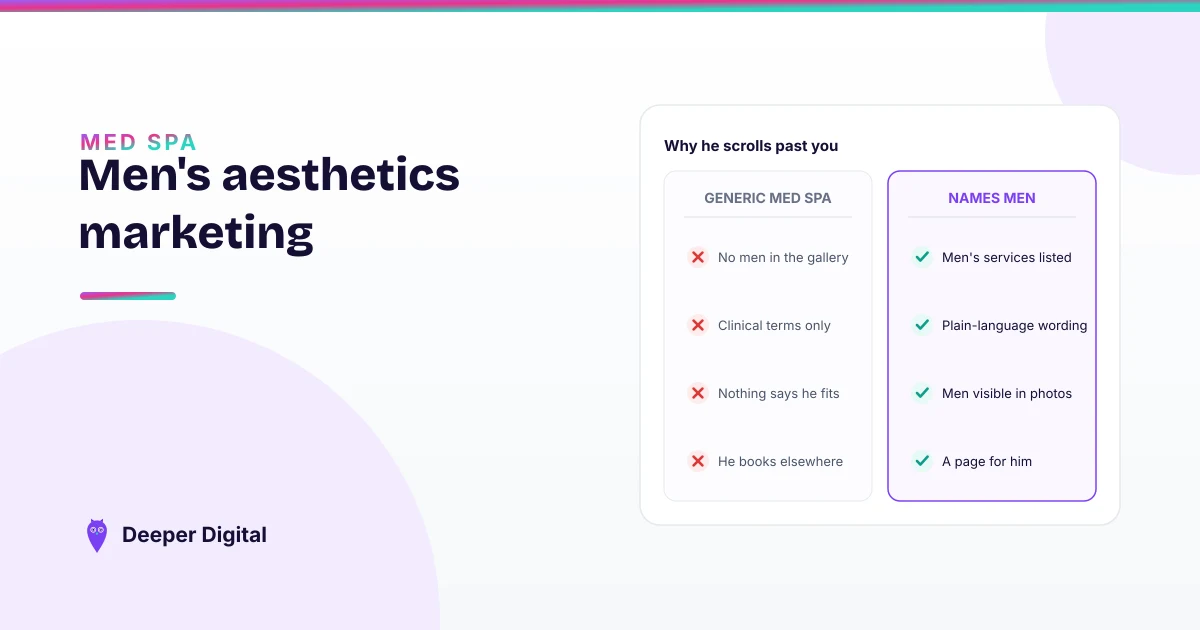
Because med spa marketing inherited its visual language from an audience that was overwhelmingly female, and never updated it. The photography, the wording, the service names — a man scanning three profiles often can’t tell whether he’s the customer.
So he doesn’t book. Not because the clinic wouldn’t treat him, but because nothing on the profile said it would. That’s a marketing gap, not a demand gap. (The general med spa playbook.)
How do men search differently?
They search the problem, not the treatment, and they do it alone.
- “double chin treatment near me” rather than “submental contouring”
- “hair loss clinic [city]” rather than “PRP restoration”
- “men’s botox near me” rather than “neuromodulator”
- “get rid of love handles [city]”
They also rarely ask a friend first. Men treat this the way they treat TRT — privately, by phone, deciding from the map pack alone. That makes search close to the entire funnel, which raises the stakes on the profile.
What should the profile actually say?
Name men’s treatments explicitly as services on your Google Business Profile, in both registers:
- Men’s botox / men’s wrinkle treatment
- Hair restoration / hair loss treatment for men
- Body contouring / double chin treatment
- Laser hair removal for men
- Men’s skin treatments
Listing “neuromodulator” alone means the man typing “men’s botox near me” never matches. Nobody at Google is doing the translating. List both the clinical term and the words he’s actually using.
Do the photos matter?
More than anything else on the profile, for this audience specifically. A gallery of exclusively female patients tells a man he’s in the wrong place before he reads a word.
You don’t need to rebuild the practice’s image. You need some photographs that include men — treatment rooms, staff, consenting patients — so the answer to “do they treat people like me” is visible in two seconds.
What about a dedicated page?
This is the move that pays best, because it’s what AI assistants and search both need to see. A single page addressing men’s concerns directly — what you treat, what it involves, what it costs, who performs it — gives you something to rank that no competitor has.
Very few clinics have this page. It is the cheapest differentiation available in an otherwise brutal vertical. (Why question-shaped pages get quoted by AI assistants.)
What are the constraints?
The same ones as the rest of aesthetics, and they’re not optional. No outcome guarantees. No medical claims. Before-and-afters only as documentation with proper consent, subject to your state board’s rules and the platform’s policies. Describe the service and the credential, never the result.
Google’s category and services guidance covers the profile setup itself.
Men’s aesthetics marketing checklist
- Men’s treatments named as services, in plain and clinical wording
- Photography that visibly includes men
- One dedicated page addressing men’s concerns directly
- Reviews from male patients where you can get them (how)
- No outcome claims anywhere
- Consistent name, address and phone everywhere (why)
The honest shortcut
This opening won’t stay open — reviews and profile age compound, and neither can be bought back later. The profile side is what we run: men’s treatments named as services, every review answered, every post signed off by the licensed provider before it publishes. The men’s page is writing on your site, quoted separately.
See done-for-you local SEO for med spas, or grab a free game plan and we’ll tell you whether anyone in your metro has claimed the men’s search yet.
 NASP
NASP  Wild Foods Co.
  Noble Origins
  Cowboy Pools
  BT Biltong