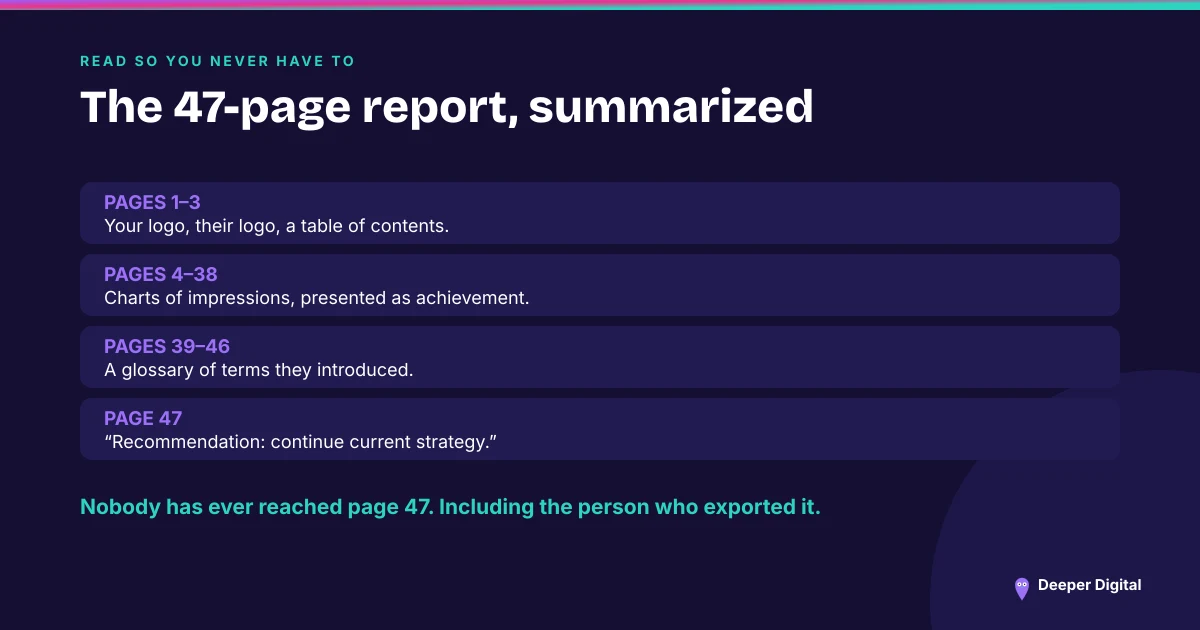
A local SEO report needs four counts and one list: calls from the profile, direction requests, website clicks, new reviews — and a plain description of what was done that month. Every one of those four is a person spending effort. Everything else on a typical report is volume, and volume moves on its own.
Length is not evidence
The reason reports run to forty-odd pages is that forty pages feel like more work than one page. It is the only reason. A long report is easier to produce than a short one, because the short one requires deciding which numbers matter and then standing behind them.
There is a second effect, less charitable. A dense report is hard to argue with. Nobody disputes a chart they did not read.
Number one: calls
Someone found the profile, decided you were plausible, and dialed. That is the closest thing to a sale that appears on any local report, and in most service trades it is the whole business.
Watch two things beyond the count: whether calls were answered, and how long they ran. Twelve calls with four missed is a different month from twelve calls with none missed, and the report does not know the difference unless somebody looks. (What one unanswered ring actually costs.)
Number two: direction requests
Someone asked their phone to take them to your address. That takes intent — nobody navigates somewhere by accident.
The caveat matters for any business that travels to the customer: if you go to them, this number will be small and should be. A mobile business with an address hidden from the profile has nothing to route to, and low direction requests there is a description of the model rather than a failure. (Storefront and service-area profiles are governed by different rules.)
Number three: website clicks
Someone wanted more than the profile could tell them. Clicks are useful mostly as a ratio: the same click count against a rising impression count means more people are seeing you and fewer are interested, which is a message about the profile itself — categories, photos, hours, the first line of the description.
Number four: new reviews
The only one of the four that compounds. A review earned in March is still working in November, and recent reviews carry more of the reading than old ones do. Counting new reviews monthly turns a vague intention into something with a number attached.
The fifth line, which is not a number
What shipped. Written out, in the order it happened, in words a person can check.
This is the line most reports omit and the one that makes the others legible. Numbers flat plus a full work list means the market is slow or the work has not landed yet. Numbers flat plus an empty work list means nobody did anything. Those look identical on a chart.
What impressions are, and why they move
An impression means the listing appeared on a screen. It counts exposure, not interest.
Impressions rise when the whole category has a busy month, when Google changes how many results a panel shows, and when a nearby competitor closes. None of that is work anyone performed. A report leading with impressions can show a healthy green arrow in a month where the phone was quieter than the one before — which is exactly why they lead with it.
Keep them on the page as context. Do not let them be the headline, and do not accept them as a deliverable.
What this does not tell you
None of the five answers whether the money made sense. That is a different calculation and it needs your job value and your close rate in it. (The break-even math, per trade.) And none of them answer how quickly to expect movement, which has its own honest answer. (What the timeline actually looks like.)
One page a month, in plain English: calls, directions, clicks, new reviews, and exactly what shipped. That is the reporting standard on every plan — short on purpose.
 NASP
NASP  Wild Foods Co.
  Noble Origins
  Cowboy Pools
  BT Biltong