One fleet account can be worth more over a year than fifty driveways, and it doesn’t stop in February. It’s the closest thing this trade has to predictable revenue.
It’s also the part of the market most pressure washing companies never bid for, which is exactly why the search is winnable.
Who is actually searching?
A fleet manager, an operations manager, or a facilities coordinator — someone whose job is to make a problem go away without creating a new one. They search formally:
- “fleet washing [city]”
- “truck washing services near me”
- “mobile fleet washing [city]”
- “commercial vehicle cleaning [city]”
- “box truck washing near me”
They are not price shopping the way a homeowner does. They’re checking whether you’re a real company that won’t embarrass them. (The commercial contract side in more depth.)
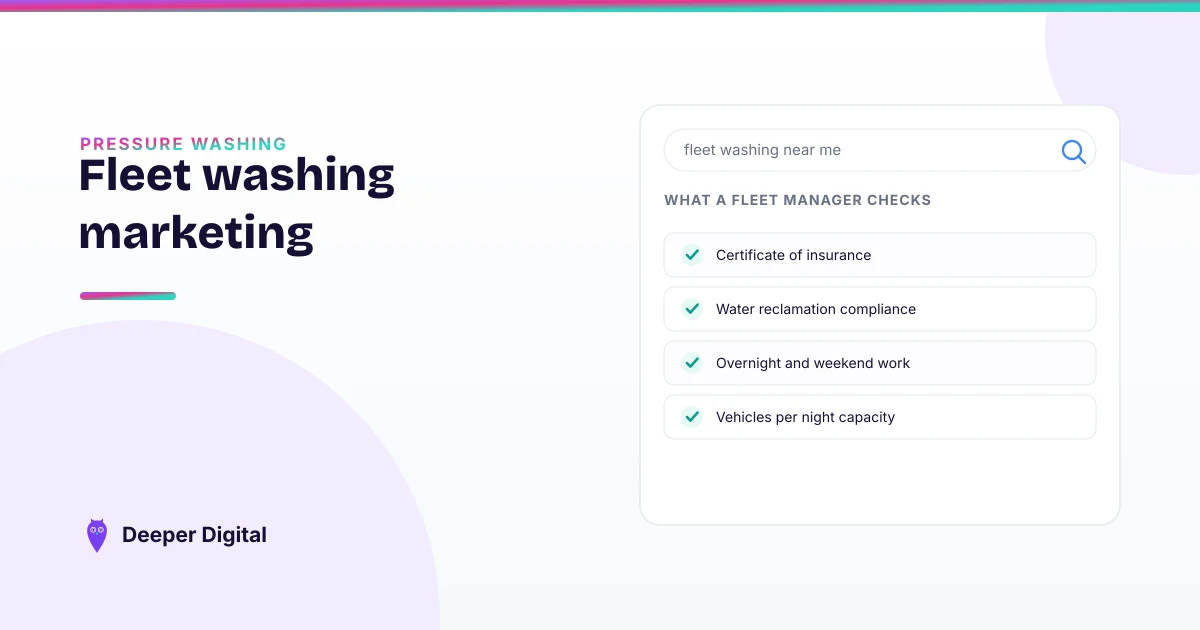
What are they checking for?
Things residential customers never ask about, and they’re the whole decision:
Insurance. Can you produce a certificate, at their limits, naming them? If this takes you a week, you’re already behind.
Environmental compliance. Water reclamation and runoff rules are real, and a contractor who creates a violation on their lot is a liability. Say plainly that you handle it.
Availability. Trucks earn money in the day. Most fleet work happens overnight or on weekends. If you can do that, it’s a headline, not a footnote.
Consistency. They want the same schedule, the same standard, the same invoice format. Boring is the selling point.
Scale. Can you do forty vehicles in a night, or four?
Where does that go?
On a dedicated fleet page, not buried in a services list. This is a different buyer reading a different page, and the language should match — capacity, compliance, scheduling, insurance, invoicing. Not “sparkling results.”
Then name it as a service on your Google Business Profile: fleet washing, truck washing, commercial vehicle cleaning. Most competitors haven’t, which is why the map pack for these terms is thin. (And the keyword picture behind it.)
Does the profile matter for a B2B search?
Yes, more than people assume. Fleet managers search on Google like everyone else, and a profile with photographs of actual fleet work, commercial reviews, and correct hours does the same qualifying job it does for homeowners. It just needs to show trucks, not driveways.
Google’s rules on how services are listed cover the mechanics.
How do you prove capability without existing accounts?
Honestly, and by showing what you can show. Photograph any multi-vehicle job you’ve done. State your actual capacity per night rather than implying more. Get your insurance certificate ready to send the same day it’s requested — speed there is itself evidence of professionalism.
What you should not do is claim accounts you don’t have. Fleet managers talk to each other, and this is a small market in most metros.
What about the outreach half?
Search brings the ones already looking. Direct outreach reaches the rest, and fleet is one of the few trades where a specific, well-researched approach still works — because the buyer is identifiable and the problem is obvious from the parking lot.
The two work together: outreach opens the conversation, and the search presence is what they check before replying.
Fleet washing marketing checklist
- A dedicated fleet page written for procurement, not homeowners
- Fleet and commercial vehicle services named on the profile
- Insurance, compliance and capacity stated plainly
- Overnight and weekend availability made prominent
- Photographs of real multi-vehicle work
- Reviews from commercial clients where you have them
- Consistent name, address and phone everywhere (why)
The honest shortcut
Writing the fleet page is your weekend or a separate quote — it isn’t in any plan. The profile side — fleet and commercial services named, photos going up, every review answered — is the steady work that decides who gets the contract call. Grab a free game plan and we’ll show you which fleet searches nobody’s answering.
 NASP
NASP  Wild Foods Co.
  Noble Origins
  Cowboy Pools
  BT Biltong